Flip the Magnet: The Pursuer–Withdrawer Dance (and How to Interrupt It)
Apr 16, 2026by Crystal Bowman, LMFT
You love each other. That's not the problem.
The problem is that somehow, somewhere along the way, every time you try to get close the two of you end up further apart. You reach. They pull. You press a little harder because you can feel them slipping. They pull a little more because now it feels like too much. And you're both sitting on opposite ends of the couch wondering what is wrong with my partner.
I see this almost every week in my office. And I want to offer you a different way to look at it.
You're not broken. You're stuck in a pattern.
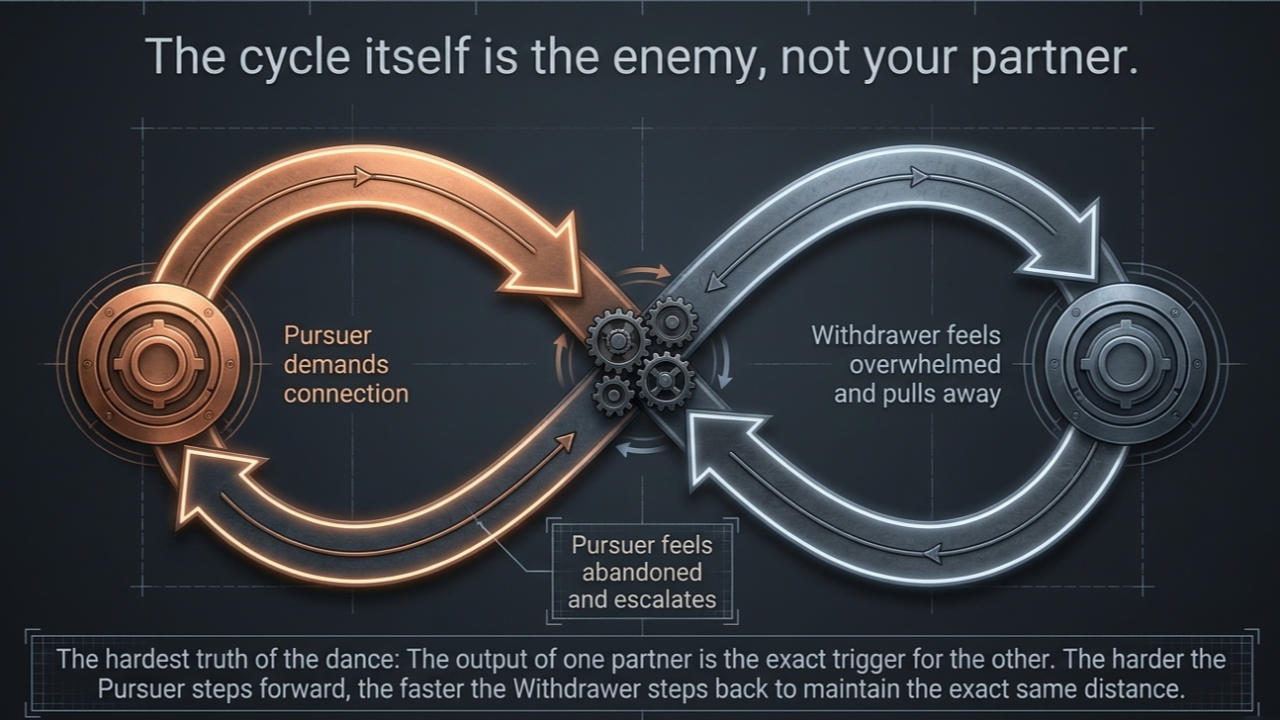
In couples work we call this the pursuer–withdrawer dynamic. One partner leans in — asks questions, wants to talk it out, wants to fix it, wants to connect. The other partner leans back — gets quiet, gets logical, avoids the emotional heat of the moment.
And both of you are walking around thinking something is wrong with the person across from you.
Here's the shift I want to invite you to consider.
What if neither of you is wrong? What if you're not a bad partner and they're not a bad partner — what if you're just stuck in a dynamic that almost every couple finds themselves in at some point?
Think of it like two magnets
I use this image a lot with couples because it helps.
Imagine the two of you are magnets, and you want to get close. You really do. But the polarity is off. So the harder one of you pushes toward the other, the more you actually repel them.
It's not that your partner doesn't care. It's that they're feeling pressure — and they don't have the tools to handle that level of intensity coming at them. And it's not that you're too much. It's that when you're leaning in hard, you don't have the tools to calm the pressure you're accidentally creating.
Both of you are doing something that makes sense. Both of you are also making it worse.
That's the part that's so hard to see from inside of it.
Something different happens when the pursuer steadies
Here's what I watch happen in session, over and over.
When the pursuer — the leaner-in — can catch themselves mid-chase and just… stand steady. Not give up. Not shut down. Not go cold. Just stop pressing for a minute and stay in the room.
The energy shifts.
Because now instead of chase-retreat, chase-retreat, there's a little space. A pause. And the withdrawer, who's been bracing for more pressure, suddenly finds themselves on different ground. The magnet flips.
And what I see on their face is sometimes curiosity. Sometimes safety. Sometimes — and this one surprises people — a little bit of desire. Like, wait. Where did you go? Come back.
Now, it's not instant. I want to be honest about that. It's awkward the first few times. It feels clunky, the way anything new feels clunky. You're not used to standing still when you usually chase, and your partner isn't used to you standing still either — they might even check to see if you're still mad.
But that clunky moment is a window. An invitation to try something you haven't tried before.
Both of you are holding important information
Here's something I really want you to hear.
The pursuer is carrying real information. They're saying there's a problem here. We need to address this. I can feel the distance between us and it matters. And most of the time, they're right.
The withdrawer is also carrying real information. They're saying not right now. Not like this. I can't meet you at this volume. And most of the time, they're right too.
Both of you are using strategies to protect the relationship and to protect yourselves. It just happens that your strategies cancel each other out.
This is the part that's so easy to miss when you're in the middle of it. You're not enemies. You're two people with different nervous systems, different histories, different tools — trying to love each other across a gap neither of you knows how to close yet.
Real connection doesn't come from pressure. It also doesn't come from silence.
It comes from both partners feeling safe enough to turn toward each other. To be steady for each other. That's the thing I'm trying to teach couples in my office — how to spot the pattern when it's happening, how to flip the magnet, and how to build something in between where both of you can actually breathe.
The pursuer learns to steady.
The withdrawer learns to stay.
And in the space that opens up between those two choices, something new becomes possible.
Something to sit with
So I'll leave you with this.
Are you the pursuer, or the withdrawer?
And the next time you feel yourself starting to chase — or starting to pull away — what would it look like to pause for just a second, and try something a little different?
You don't have to know yet. You just have to notice.
That's where the magnet starts to flip.
Crystal Bowman is a Licensed Marriage and Family Therapist at Arizona Family Institute in Mesa, Arizona. She specializes in helping couples move out of stuck patterns and back toward each other.
Don't miss a beat!
New moves, motivation, and classes delivered to your inbox.
We hate SPAM. We will never sell your information, for any reason.
