Why Willpower Keeps Failing You: The NOW and the Reach
May 21, 2026By Dan Oakes, MEd, LPC, CSAT — Arizona Family Institute
Why does willpower fail with pornography addiction and compulsive behavior? Why do I keep going back to something I don't actually want? Is porn addiction really a brain disease, or is it something else? These are some of the most-searched questions I hear from men in recovery, and the honest answer reframes almost everything. Compulsive behavior is not a willpower problem, and it is not a disease of the brain. It is an attachment disorder. And once you understand that, the question shifts from how do I stop to how do I retrain my nervous system to come home to real connection.
That's what this post is about. I'm going to walk you through two practices I teach in our men's groups at Arizona Family Institute — the NOW practice and the Reach — that work because they speak the language your nervous system actually learns in. Not behavior modification. Not day-counting. Self-regulation and co-regulation are the same way you learned to feel safe in the world the first time around.
Let me start with the part of you that has spent years asking, " Why do I keep going back? It doesn't align with my values. I don't want to do it anymore. And still, here I am. There's a gap of confusion in there, and most of us have lived in it for years.
I'm going to have the audacity to tell you why.
It's not a disease. It's an attachment structure.
For a long time, compulsive behavior was framed as a disease model. Something is wrong with your brain. Your brain is different from other people's brains. Other people can drink socially, but you're an alcoholic. That was the language.
The truth is closer to an attachment disorder. Here's what I mean. When we're young, we learn attachment structures. A baby comes out of the womb crying and gets soothed. The doctor wants the baby skin-to-skin with mom as soon as possible. The touch, the warmth, the breast milk — all of it has a calming effect. And the baby learns very quickly, in the right side of the brain, pre-verbally, in a felt sense: when I cry, soothing comes. Somebody cares for me.
It gets a little more sophisticated by age two. Mom or dad baby-proofs the living room so the kid can play while they do the dishes. The kid falls off the chair and scrapes a knee. What happens? Panic, and a run to mom or dad. And mom or dad soothes. That's biology. The baby is designed to cry. The parents are designed to respond.
We grow up within the context of a secure base to different degrees. Some of us had a stronger one, some of us had less. But the structure is biological. When the nervous system feels distress, it immediately looks for: "Where do I go?" You cannot remove that from the human soul. We get more independent in the world, but the part of us that craves return to a safe place never leaves. It just moves — from parents, to friends, to partners. Along the way, we also have to learn how to connect to ourselves.
Here's the catch. The attachment structure can get hijacked. By what? By anything more stimulating than the comfort of a mother. And what's more stimulating than that? A lot. Video games. Social media. Pornography. If we create a pattern where distress turns toward those things, the attachment structure latches onto them. So when we apply a behavioral model — just stop, count the days you don't do it — the nervous system protests. What the heck, where's my survival skill? What do you expect me to do?
That's why willpower feels like more than we should need. Because the nervous system is kicking back immediately. It doesn't know what's been hijacked. It just knows it wants to come home.
The baseball player and the elbow
I had a client years ago who was a pro baseball player, and he told me a story I now use all the time. When he got to the minor leagues, a batting coach pulled him aside and said, " You're never going to break .500. Why? Because you drop your elbow. You've been doing it since Little League. It got you this far, but it won't get you further. You will not hit major league pitching with that elbow dropping.
He asked, what do I do? The coach said, You have to do exactly what I tell you. They took a roll of duct tape and taped his elbow up — under the elbow, over the top, all the way to the side of his batting helmet. So his elbow was pinned up, exaggerated, awkward. The coach said, "Now hit the ball 500 times."
He told me it took three or four days. He could barely make contact. But he did it. And when the tape came off, and he stepped back into the batter's box, his elbow floated up on its own. He couldn't believe it. His batting average climbed. He broke .500. And throughout his career, whenever he felt the old pattern coming back — when he could feel the elbow start to drop — he would tape it up again.
That's what we're doing here. The muscle memory is unconscious. We learned how to move through the world at a very young age, and we don't always know what we got wrong. He got enough right to make it to the minor leagues. He didn't have enough to get all the way. Unconscious mechanisms will pull you back into old patterns unless you exaggerate the new ones.
So willpower is not a tool I use. I don't want you to count days. Don't tell me you went twenty-nine. I don't care. Because what happens? You'll go twenty-nine and slip the night before your goal. And then you'll call yourself a failure. But the slip isn't a failure of character. It's the nervous system protesting. You're isolating me. You're putting me in a box. Where is my connection?
Your nervous system doesn't know the difference between pornography and a real connection. It's just protesting the loss. So we don't count the slips. We count the new pattern. And we have to do it more often than feels necessary, and with greater exaggeration, to move the system back into alignment with your values.
The NOW practice
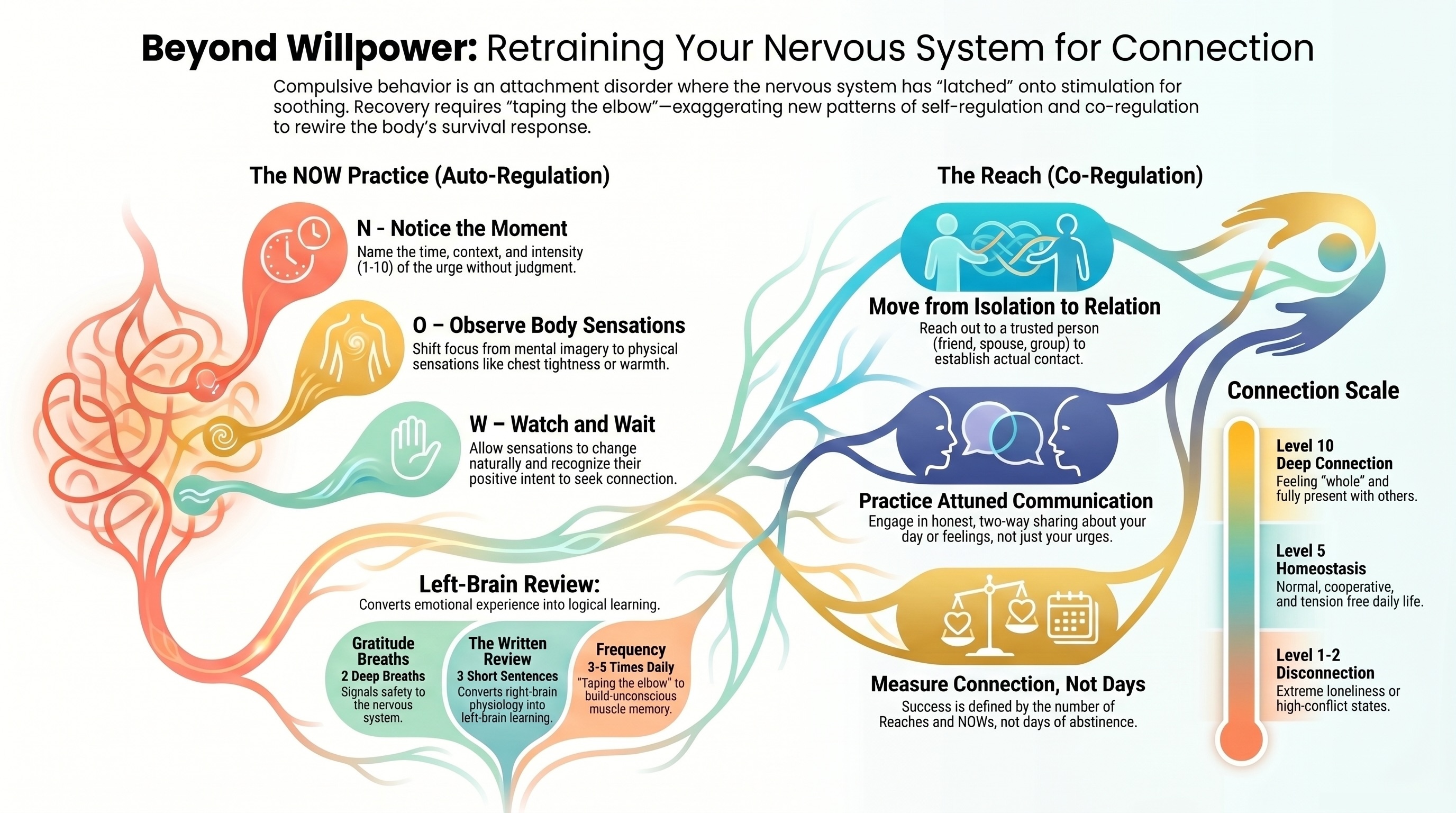
There are two skills I want to give you. The first is the connection to the self. We call it the NOW practice. NOW is an acronym, and I love acronyms.
Here's how it works. You start to feel the urge. Maybe it's sexual hunger, maybe it's that preoccupied, restless, I-need-something feeling. You notice it. You begin a meditation. To start, take two simple, deep breaths and then let your breathing return to normal. I call these gratitude breaths. Because if you watch closely at the bottom of that second deep breath, your nervous system takes over breathing for you. You didn't choose it. It's caring for you. There's a moment of gratitude in that. My body is good. My body will care for me. It takes two or three seconds. That's the readiness.
Here's what that looks like in my own life. It's eleven o'clock at night. My wife has been in bed for an hour and a half. I'm in front of the fridge, looking. I'm not actually hungry. I'm lonely. But the looking — the standing there, the searching — that's the part that gives me away. The body is reaching for something. And if a guy has been looking at porn since Little League, the body knows exactly where it's been trained to reach. So before that pattern runs, the NOW practice lets me stay right there, at the fridge, and meet what's actually happening.
Then the acronym.
N is notice. It's Thursday night, eleven-thirty. I've had a long work day. I'm feeling lonely. That hungry, I-need-something feeling is here, and tonight it's strong. Last night was easier. Tonight it's a seven, or a thousand, or whatever scale you want. You rate it. You name it. You put it in context and time. That's all the N is. I'm here. It's here. I'm in the now.
O is observe. This is the critical move. Compulsive behavior — pornography especially — trains you to stay up in your head, watching imagery. What we do instead is bring awareness down to the solar plexus and name sensation. Warmth in the chest. Fluttering in the gut. Tightness in the shoulders. Some guys describe a rock right here, in the chest. You're going to feel real things because early arousal has a very specific physiologic blueprint. Heart rate goes up. Respiration rate goes up. Galvanic skin response — the skin gets supersensitive. Blood flow starts to shift. You feel almost prickly, agitated, but that's not agitation, that's receptivity. The body is preparing for connection.
When you name the sensation, you start to recognize that the intensity is safe. It's safe in your body. It's not going to force you to do anything. And you can see its positive intent. It's trying to help you not be lonely. You are not fighting it. You are observing it.
W is watch and wait. Watch it change. Because it will change. The brain is an active motor. Even when you sleep, streams of consciousness keep moving. If you stay with a sensation long enough, new ones show up. In a compulsive state, you might get fixated for a little longer, so we don't push. We just wait. New thoughts arrive. You start thinking about a problem from work, you can suddenly solve. You think about your grandkid. You think about that backpacking trip you can't wait for.
If it feels stuck, I sometimes add a small piece of imagery. Picture a river flowing from upstream behind you, down through the back of the neck, through the solar plexus, and out. One guy did this last week and said, the second I saw the river I saw grandpa fishing in it. Grandpa loved to fish. I want to fish with him. Imagine it. So we imagined it.
There's no judgment in this. There's no pushing. We are joining the urge. We're appreciating its positive intent. If we just shove urges away, we tell the attachment system that we are more alone. Don't reach. Don't connect. And it protests. So we hold it instead. We baby-proof the living room for it. Because what did you need at eleven, or twelve, or fourteen? You needed somebody to sit next to you, put an arm around you, and say, you okay? This is normal. You're not bad. I'm glad you came to talk to me. Sexuality is normal. It's designed to keep you connected. Those feelings are a signal that you need closeness.
That nurturing moment — the NOW gives you the chance to be that for yourself.
Write it down. Tape the elbow.
It's not over when the meditation ends. If you want the learning to stick in your bones, take forty-five seconds and write a simple paragraph. Three short sentences.
Thursday night, eleven o'clock. Intensity about a seven. I noticed tightness in my chest. I noticed heat — probably my heart rate. I noticed that gut feeling. I noticed feeling prickly, which I now think is the need for closeness. Then I saw a river. I thought about Disneyland when I was a kid. I thought I forgot to pay the utility bill.
Three sentences. That's it. But here's what happens when you write it. You take a right-brain, physiologic, emotional experience and convert it into a left-brain review. That is a learning pedagogy that works. That is taping the elbow up. The baseball player watched film. Then he went out and practiced the throw from second to third base twenty times. You have to be willing to tape the elbow.
This is what we count. The meditation plus the writing is one. I tell my clients we need a hundred of those. Don't wait for the urge to practice. Practice cold. Three times a day. Five times a day. Six times a week. You can remember an urge — practice the process with the memory of it. The structure looks rigid, but it is biologically consistent with what your nervous system actually needs.
The Reach
The NOW is the beginning of auto-regulation. Co-regulation is the second move. We call it the Reach.
The real intention behind sexual energy is a signal from your body that you need connection. So when the urge comes, you reach. Reach has critical elements. It is relational — I am getting outside of myself to another person. It is attuned — there is actual contact, not performance. And it lives in high levels of honesty. I am not going to lie to the person. I'm not going to gaslight them. I'm just reaching.
You need people in your life. Members of a group. A best friend. Your wife. A cousin. A brother. Your dad. It doesn't matter who, as long as there are several. For so long, you've dropped your elbow into loneliness and gone to a screen alone, and your nervous system thought, yay, lots of women. But that part of the brain doesn't know the difference between real people and pictures of people. The rest of you know. The next morning, you know.
Attuned communication is two-way. Hey, what was the best part of your day? Then you ask, what was the hardest part? And you get something back, and you share something back. If your buddy says, " My day was fine, you can press a little. Doesn't sound fine. You okay? Even if it stays at, I'm just worn out, that's contact. You don't have to talk about feeling sexual. You can say, I'm lonely. I'm feeling high energy. I just need to connect. Then you talk about the backpacking trip. The Suns game. Anything. Just attune.
Even a three-second text counts. Hey, having a rough day. And your buddy texts back, I got you, I'm here, check in later. You're at work, he's at work, but the Reach landed.
The biggest hurdle in relational skills is the Reach itself. You have to do it often, and before you think you need it. I tell guys, tape the elbow. Reach three times a day for a while. Six times a week. Track it. Tell your buddy, hey, I'm going to wear you out for a few weeks because I have to practice reaching. And the buddy says, I've got your back, reach out anytime.
If you're in a group, use the group chat. Throw the Reach in. Hey, guys, I'm reaching. I'm feeling intense. I did the NOW, got through it pretty well, but I need a connection. And someone says, Give me a call. Let's do a NOW together. Double-barrel. What would that be like? That's really taping the elbow up.
Measuring connection, not days
In our group, I teach the guys to track more than just days of abstinence. We track connection level on a scale of one to ten. Five is homeostasis. Five is the good stuff — connected, cooperative, normal. You ask your wife to hand you the broom while she's doing the dishes. You sweep it up. Things are fine. No tension.
Ten is a deep connection. For me, ten is sitting on the beach in Hawaii with my wife. Or yesterday — one of our ten grandkids graduated from kindergarten, and we picked her up after school and took her for ice cream. That made her whole day. That was a ten. I didn't need anything else. I saw that smile, and I was ten. That night, my wife and I were lying in bed, and I was still riding it. Nine, ten. Easy.
Below five is disconnection. One might be an extreme argument or deep loneliness. Maybe you've been working too much and haven't had time together, and you say, " We have to get away this weekend, we at least have to drive to the gas station for a soda and sit in the parking lot. That's a ten for my wife — if I come in the door with caffeine for her, I am the bomb. That's a whole conversation about addictions, by the way. I'm her dealer.
When she puts her hand on the back of my neck while I'm driving, I want to roll the window down and wave at strangers. Hello, children, I am the king. Something about that contact, and I'm at ten without leaving the car. But when she's not touching me, when she's upset because I suggested a modular trailer instead of building a house on our land, and she doesn't talk to me for half an hour — that's a two. I'm making light of serious things. I know what a big fight looks like. I know what big disconnection looks like. Some of you know exactly where you are on that scale.
So in the group, here is what we measure. Number of NOWs since the last meeting. Number of Reaches since the last meeting. Connection level in general over the last two weeks. Connection level in this room, today. Guess what number isn't on that board? How many days have you gone without looking at porn or masturbating? Not even there. That's a failed system.
If you come in with fifteen NOWs and twelve Reaches, you're going to think I'm a genius. I'm not. This is just good science. The evaluation is the point. We want you to sense your connectedness in the world, because none of us lives at a ten. Five is homeostasis. Five takes work. You have to keep your elbow up.
The harder truth underneath all of this
I want to tell you about a study. They put rats in a cage with high-value food locked behind a mechanism that required some figuring out. The rat figured it out. Then they put a second rat in the same kind of trapped mechanism, and they put the first rat in the cage with both — the food and the trapped rat. Every time, the rat went to the other rat first. Got him out. Then they both went and opened the food and ate together. Every time.
Then they introduced a drug. I forget which one — a mood stabilizer, an anti-anxiety compound, something like that. Not once. Not one time did the rat go for the other rat. It went for the food every time. It still remembered how to open the cage. The skill was there. The desire for connection was gone.
That's the danger. If we stay in a compulsive behavior too long, it mutes our desire to connect. It mutes it. And our skills at connecting atrophy with it. That's why we have to tape the elbow. That's why we have to exaggerate the new pattern. The change elements are unconscious and learned very early. The mechanisms have to be felt, sensed, and repeated.
If you're struggling, come and say it
This is not a behavioral intervention. It is an intervention of compassion — for yourself, and from us, alongside you. You may still slip. Don't fall back into the old elbow-dropping pattern where you do this ten times and slip once and call it a failure. That is old thinking. If you do this a hundred times, and then maybe another hundred times, the system will change. I guarantee it.
And here's how you'll know. Clients tell me, I don't even understand what happened. I just decided not to do it that day. It didn't require willpower. Yeah. Your elbow came up on its own. You're practicing the skills that matter.
Don't be afraid to be afraid. If you come back in three weeks and you haven't done any of it, that's okay too. It just means you're really alone. And we want to help. We see the pain. There's no judgment here. We're just learning, together, how to come home.
Don't miss a beat!
New moves, motivation, and classes delivered to your inbox.
We hate SPAM. We will never sell your information, for any reason.
