
The Layaway Plan: Understanding the Long Work of Betrayal Repair
Apr 29, 2026By Mark Bell, LMFT, CSAT — Arizona Family Institute
How long does it take to recover from betrayal? When will my spouse stop being triggered? Why does her pain keep coming back even when we're doing well? If you've sat across from your wife after disclosure and asked yourself any of these questions about betrayal trauma, infidelity recovery, or what real repair after betrayal actually looks like — this is for you. Most of the men I work with want a timeline. They want to know when the consequences end. I want to offer a different way of thinking about it. (see my video on this topic)
A Memory From My Mom
A long time ago, when I was a kid, my mom would purchase things on layaway every now and then.
Some of you know what that is. Some of you don't. Back in the day, you could go into a department store, pick out something you wanted, and you wouldn't get to take it home right away. The store would hold it for you in a back room somewhere. You'd make payments over weeks or months, and when you finally paid it off, you got to walk out with what you bought.
I was thinking about layaway recently while sitting with a client.
What He Couldn't Understand
He was telling me about these consequences that keep showing up. These pain points his betrayed spouse experiences. And he's doing the work — really doing it. He's in great recovery. They've put a lot of effort into healing, and by and large their relationship is in a good place.
But he still gets perplexed. Overwhelmed sometimes. Frustrated, honestly. Because his wife still gets triggered. And often, the trigger has nothing to do with anything happening between them in real time. It's something external. Something in the world pulls her right back into the injury.
He couldn't make sense of it. If we're doing so well, why is this still here?
I told him: " Look, it's interesting. And I brought up the layaway plan.
What You Actually Purchased
You caused your wife's pain when you made those decisions.
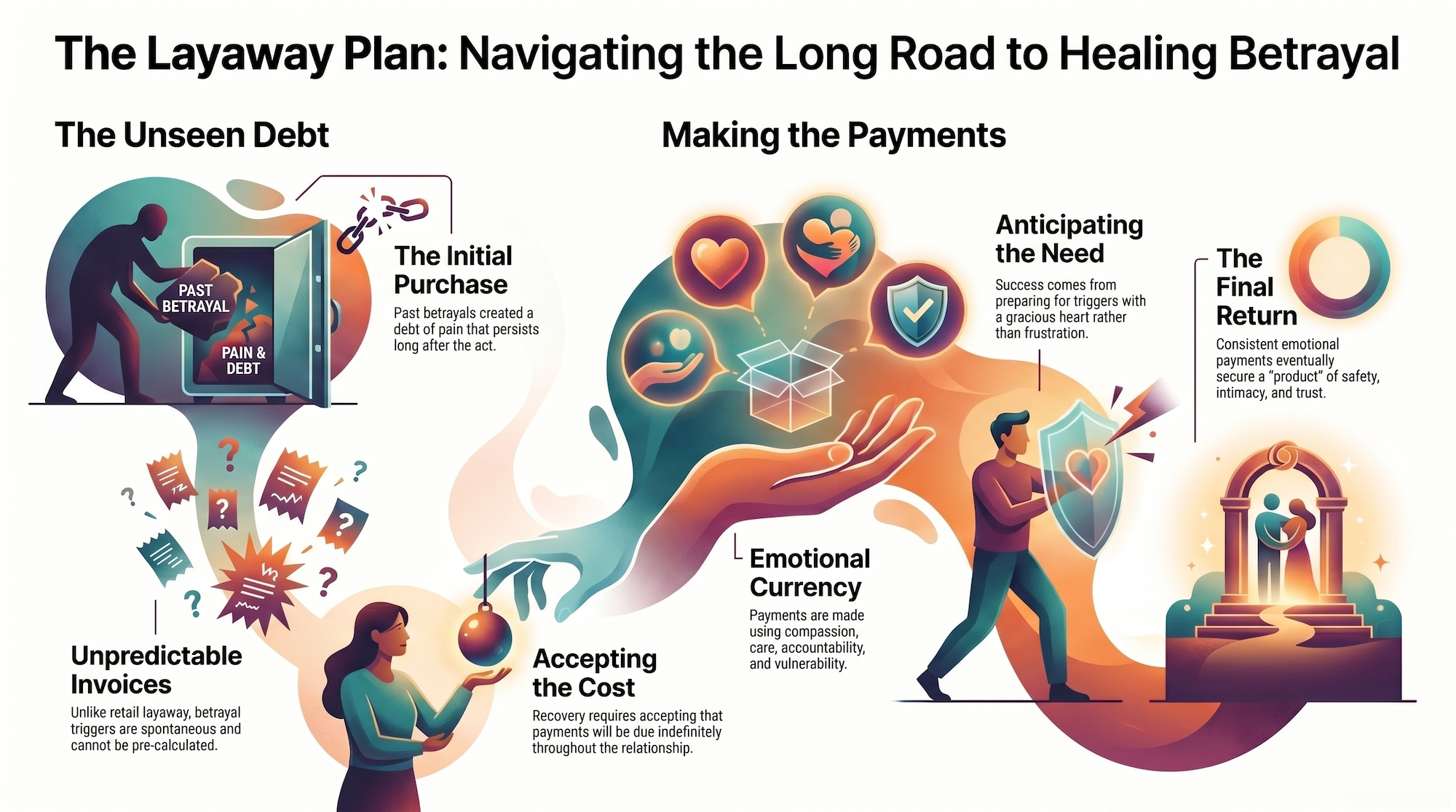
That's what I told him. You made an unwise investment back then — what you got for what you paid. And there are going to be payments that need to keep being made, because her pain is going to keep showing up. Sometimes weeks later. Sometimes months. Sometimes years. Not always at the same intensity. But there are still payments to be made because you purchased something that will be paid off over the duration of the relationship.
That's hard to hear. I know. But it's the truth of it.
The Difference Between Layaway and This
Here's where the metaphor breaks open in a useful way.
With a department store layaway plan, you know when the payments are coming. The schedule is set. There's a date. There's an amount. You can plan for it.
In betrayal, the injuries don't work that way. You can't calculate when it's going to happen. Neither can your betrayed spouse. The payment comes due spontaneously. A song. A scent. A scene in a movie. A name that comes up on the news. And suddenly the pain is in the room again, and a payment is due, and neither of you saw it coming.
That unpredictability is part of what makes this so disorienting for the betraying partner. You want a calendar. There isn't one.
Why It's Still Worth Paying
But here's what I want you to hear.
If you can understand — I made a purchase in the past, and I'm paying it off over time — then what you get from those payments is what you actually wanted in the first place. Intimacy. Connection. Safety. Trust with and for your wife.
The payments come. They need to be paid. And if you can understand that ahead of time, rather than getting surprised by it, you prepare for it. You anticipate it. You come with a gracious heart that says: Wait. I made this investment back in the day. I committed to making payments over time. I didn't know at the time that's what I was doing. But I have to accept now that that's what it is.
When you show up that way, your wife gets what she actually needs from you. Compassion. Care. Accountability. Vulnerability. Thoughtfulness.
That's the payment. That's what's owed.
What Changes Over Time
So we make those layaway plans, and we pay them off over time, and sometimes indefinitely.
But what we purchased back then — it changes. Because in this season, in this work, you're getting something different. You're getting safety. You're getting trust. You're getting healing.
So be mindful about what you purchase. Because it may take a long time to heal it.
In this case, it's worth it.
Don't miss a beat!
New moves, motivation, and classes delivered to your inbox.
We hate SPAM. We will never sell your information, for any reason.
