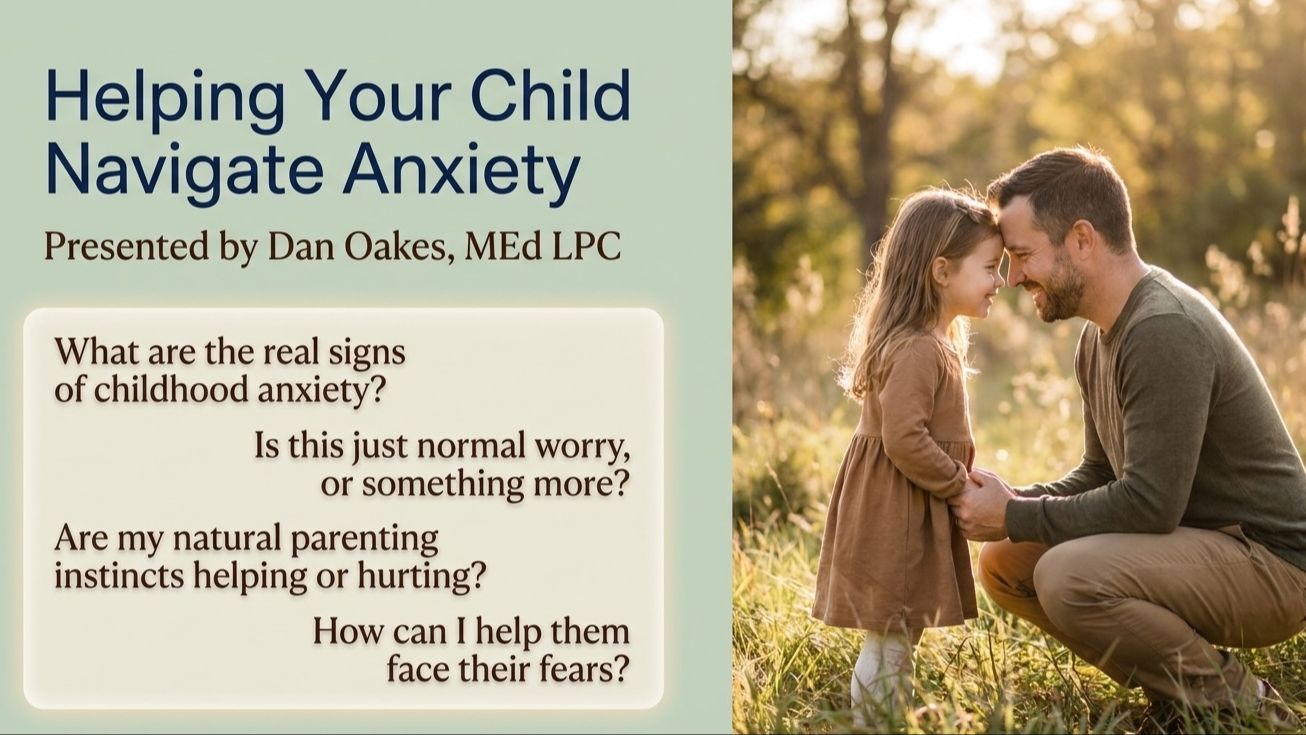
Helping Your Child Navigate Anxiety: A Guide for Parents
May 29, 2026By Dan Oakes, MEd, LPC — Arizona Family Institute
If you're a parent up late searching How do I help my child with anxiety, what are the signs of childhood anxiety, or Is my child's worry normal, you are not alone — and you're in the right place. Maybe your child is dealing with school refusal, separation anxiety, frequent stomachaches with no medical cause, or trouble sleeping alone, and you're wondering whether this is ordinary childhood worry or something more. Understanding the signs of anxiety in children, the root causes, and the most effective childhood anxiety treatments is the first step toward helping your child break the anxiety-avoidance cycle and thrive.
Let me put it in a real moment, because that's where this lives. It's 9:40 at night. You've read the book, said the prayer, refilled the water cup twice. And there's the small shape in the doorway again. My tummy hurts. I can't sleep. Will you stay? You sit on the edge of the bed, and you can feel the little hand gripping your sleeve like the dark is going to take you both. Or it's the morning version — a backpack hits the floor and a seven-year-old plants their feet at the front door and says I'm not going. Parents bring me these exact scenes in my office every week.
So let me say the thing I want you to hold onto before anything else. Your child is not broken. Their alarm system is just a little too sensitive right now, and a sensitive alarm can be retrained. That's the whole project. Not making the fear disappear — you can't, and you wouldn't want to. Teaching a nervous system that the world is safer than it feels.
It's a false alarm, not a real fire
Anxiety is not a defect. It's a protector. It's the feeling we get when the body senses something bad might be coming and flips on the fight-or-flight response to keep us safe. Heart speeds up. Breathing gets shallow. Stress hormones flood the body and prepare the muscles to run or fight. That system is good. It's the reason your ancestors survived long enough to have you.
Here's the catch with an anxious child. The alarm starts going off when there's no fire. It's like a smoke detector that screams every time you toast a piece of bread. Nothing is burning. The toast is fine. But the detector doesn't know the difference between burnt toast and a house on fire — it just knows it's built to sound the alarm, so it does. Loudly. Every time.
A child's nervous system can get wired that way too. A pop quiz, a sleepover, a new classroom, a dog across the street — the alarm fires at full volume, and your child genuinely feels the danger in their body even though you can see plainly that there isn't any. This matters, because the first thing a frightened child needs to hear from you is not calm down. It's I believe you that this feels scary. The fear is real even when the threat is not.
What anxiety looks like when a child can't name it
Most kids don't walk up and say, I'm experiencing anticipatory anxiety about tomorrow. They don't have the words yet. So the body says it for them, and the behavior says it, too. Our job is to learn to read the translation.
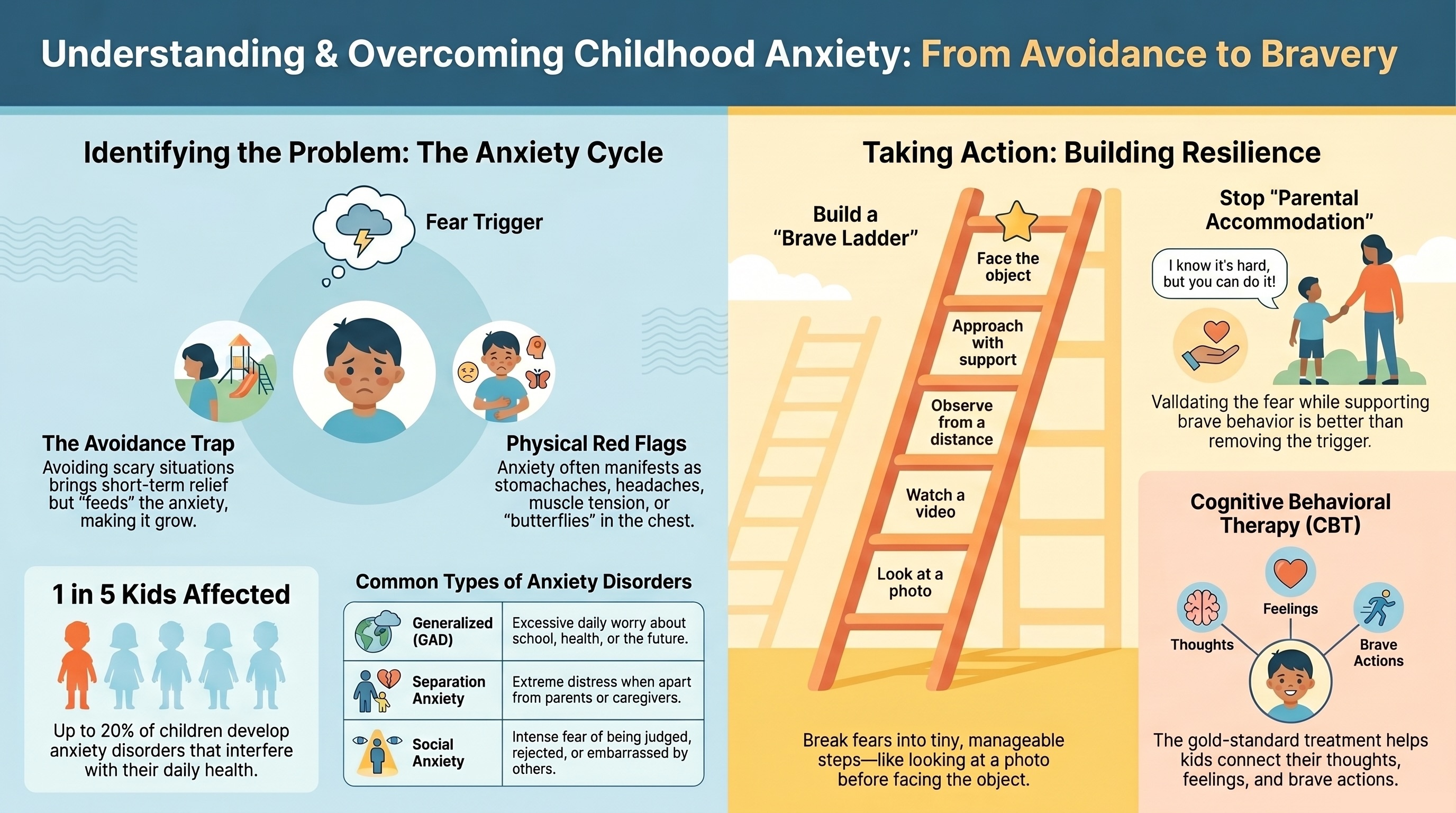
In the body, you might see a racing heart, sweaty little palms, butterflies, or a stomachache that shows up right before school and mysteriously clears by mid-morning. Headaches. A throat that feels tight. Trouble falling asleep, or waking in the night needing you.
In behavior, it often looks like clinginess — the child who won't let you out of sight. Tears that come fast and big. Meltdowns that seem out of proportion to whatever set them off. Refusing to go to school, refusing to sleep alone, refusing the birthday party they were excited about last week. And sometimes it doesn't look like fear at all. Sometimes anxiety wears the mask of anger, or stubbornness, or a kid who suddenly won't cooperate about anything. A child melting down at the door is not giving you a hard time. They are having a hard time. Those are different sentences, and the difference is everything.
Why saying "no" feels so good — and why that's the trap
Here's the part that surprises most parents. The single most common way anxiety gets stronger is through avoidance. And avoidance feels great. That's exactly the problem.
Watch what happens. Your child is terrified to raise their hand in class. The fear builds and builds. Then the teacher moves on, or you let them stay home, and — whoosh — instant relief. The body floods with that sweet sense of made it, I'm safe. The brain is paying very close attention. It just learned a lesson: avoiding the scary thing made the bad feeling stop. That's called negative reinforcement, and it is one of the brain's most powerful teachers.
So the next time the scary thing shows up, the pull to avoid is even stronger. The fear didn't shrink. It grew. Every time we help a child hide from what scares them, we mean to comfort them — and instead we accidentally feed the worry a giant snack. Avoidance is the food anxiety grows on. I know how counterintuitive that is. Every cell in a loving parent wants to remove the hard thing. But removing the hard thing is what keeps the alarm wired tight.
You are the secure base
Before I hand you any technique, I want to name the most important tool in the room, and it isn't a worksheet. It's you.
Think about how a baby learns that the world is safe. The baby cries, and someone comes—picks them up, holds them skin-to-skin, and the crying settles. Down in the right side of the brain, before language, the baby is learning something it will carry for life: when I'm in distress, I have somewhere to go. That's a secure base. Your child still runs on that same wiring. When their alarm goes off, the very first thing their nervous system asks is, where do I go, and is my person steady?
This is why your own calm is not a nice-to-have. It's the intervention. A child borrows their parent's nervous system before they can run their own — we call it co-regulation. If you meet their panic with your panic, the alarm gets louder. If you meet it with a steady voice and slow breath and a body that isn't bracing, you hand them something to settle into. So before you fix anything, regulate yourself. Drop your shoulders. Soften your voice. You first, then them.
And here's where being a steady base gets misread. Many of us think the loving move is to rescue — to speak for the shy child, to call the school, to quietly let them skip the thing. That's parental accommodation, and in small doses it's human and fine. But when it becomes the pattern, it sends a quiet message beneath the surface: I don't think you can handle this, so I'll handle it for you. It lowers their fear in the moment and lowers their confidence over the long run. The goal is not to remove the wave. It's to stand in the water beside them as they learn to ride it. Validate, don't rescue. I know this feels scary, and I know you can do hard things. Both halves of that sentence, every time.
Raising a brave scientist
Once your child knows you're steady beside them, you can start the actual retraining. I tell families to turn their kids into Brave Scientists — little investigators who go out and gather evidence about whether the scary thing is really as dangerous as the worry claims. The worry makes a prediction. The scientist checks it. Here's how that looks in practice.
- Build a brave ladder. Don't ask a child to face their biggest fear in one leap — that's how we create a bigger crash. Break it into small, doable steps and climb one rung at a time. If sleeping alone is the fear, the ladder might start with you sitting in the doorway, then sitting in the hall, then checking in every ten minutes, then every twenty. Gradual exposure. Each rung is a small win the body can stand on before reaching for the next.
- Validate, don't rescue. I'm saying it twice because it's the hinge the whole thing turns on. Name the feeling out loud so your child knows you see it — I can tell your tummy is doing flips — and then express your quiet confidence in them: I've seen you be brave before. You've got this. Warmth and a gentle expectation, side by side.
- Teach the secret tools. Give the body something to do when the alarm fires. The simplest one I teach is the flower and the candle. Breathe in slowly through the nose like you're smelling a flower, then breathe out slowly through the mouth like you're blowing out a birthday candle. Long, slow out-breaths are not a trick to calm kids down — they're a direct signal to the body that the danger has passed. Practice it when everyone's calm, on the couch, not for the first time in the middle of a meltdown.
- Treat every brave step as an experiment. After your child faces something, get curious together. You were so worried no one would play with you at recess — what actually happened? Nine times out of ten the dreaded what-if didn't come true, and the times it did, your child survived it and is sitting right there to tell you. That's the data. Over and over, the experiment teaches the same beautiful lesson: I am stronger than my worry thought I was.
When you're ready, you don't have to do it alone
None of this is fast. It's patient work — a rung at a time, a breath at a time, a lot of standing in the water beside your child when everything in you wants to carry them out of it. Some nights you'll do it beautifully. Some nights you'll lose your patience and snap and feel awful, and that's okay too. Repair is part of the work. There's an old line about how perfect love casts out fear, and I think of it often in this work — not because we love perfectly, but because a child who feels safely loved slowly learns that the world is a place they can meet without bracing.
If your child's worries are getting in the way of school, friendships, sleep, or just the ordinary joy of being a kid, that's worth taking seriously — and it's worth getting some company for. You don't have to figure out the whole ladder by yourself. If you'd like a hand, come and say so. Reach out to schedule an appointment at the Arizona Family Institute, and we'll work alongside you to help your child build the courage and tools to live a big, brave life. Come as you are, scared and tired and trying. That's exactly the right time.
Don't miss a beat!
New moves, motivation, and classes delivered to your inbox.
We hate SPAM. We will never sell your information, for any reason.
