
Loneliness Is Not a Phone Problem
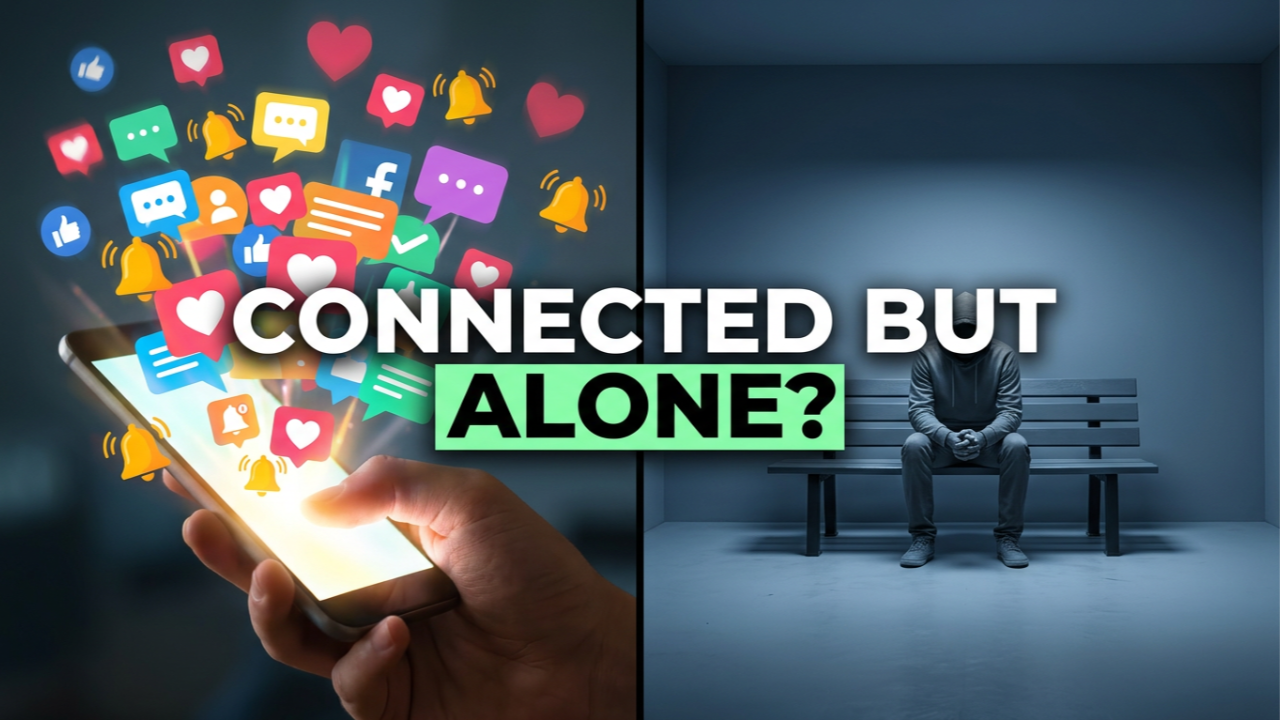
by Dan Oakes MEd LPC
A young man sat in my office last spring and told me he had 432 people he could text right that minute. See our video on this topic.
He counted them. He'd actually counted.
And then he said, quieter, "I don't think any of them would notice if I didn't."
I've been doing this work long enough that I don't rush into the silence anymore. So we sat there. And what I kept thinking about was how often I hear a version of this — from twenty-two-year-olds, from fifty-year-olds, from men in my Monday morning group who have wives and children and callings and coworkers. Why do I feel so alone when I'm never actually alone? It's one of the most common questions people bring to therapy, and it's almost never asked out loud in those words. It comes out sideways. It comes out as numbness, irritability, or a habit that won't quit.
Here's the thing I want to say plainly, because I think the standard advice has failed people.
Loneliness is not a phone problem.
Social isolation and loneliness are not the same thing
We use these words as if they're interchangeable, but they aren't.
Social isolation is objective. It's a measurement. It's whether there are other human beings near you. You can count on it.
Loneliness is subjective. It's the distress that shows up when the interactions you are having don't actually feed you. Which means a person can be surrounded — genuinely surrounded, at a dinner table, in a full pew, in a group chat that never stops buzzing — and still be starving.
That distinction matters clinically, because if you treat loneliness as an isolation problem, you'll prescribe proximity. Go to the party. Join the group. Get out there. And the person will go, come home, and feel worse — now with the added shame of having done the right thing and gotten nothing in return.
What the research actually found
There's a large longitudinal study out of King's College London that pushed back on the advice most of us have been repeating for a decade.
The finding is this: total screen time predicts loneliness far less than we assumed. What predicts it is the kind of use.
When young adults use their devices for active communication — messaging a friend, reaching toward someone, an actual back-and-forth — loneliness goes down.
When the same young adults shift into passive consumption — scrolling curated feeds, watching, absorbing, never reaching — loneliness goes sharply up.
Same phone. Same hour. Opposite outcome.
I find this enormously hopeful, and I want to explain why. It means the intervention isn't deprivation. It's redirection. Nobody has to throw their phone in the ocean. What has to change is the diet.
Junk food for the nervous system
Passive scrolling functions like biological junk food. It occupies time and attention and delivers almost no nutritional value for connection. You get the sensation of having been social. You get none of the substance.
And the body knows. That's the part people underestimate.
Chronic loneliness registers as a threat. The brain reads disconnection the way it reads danger — as a signal that something has gone wrong in a way that could actually kill us — and it responds by staying up on the wall, scanning, never quite standing down. That's not a metaphor about feelings. That's a stress response running for years.
The U.S. Surgeon General, Vivek Murthy, took the unusual step of issuing a formal advisory on this. Lacking social connection carries a mortality risk on the order of smoking fifteen cigarettes a day. More dangerous, in terms of numbers, than physical inactivity. More dangerous than obesity.
We do not treat it that way. We treat it like a mood.
What I'd actually ask you
I'm not going to hand you a system.
But I'll ask you the question I asked that young man, after we'd sat in it a while:
Of everything you did on your phone yesterday — how much of it was reaching, and how much of it was watching?
He didn't answer right away. He looked out the window. And then he said, "I haven't reached in a long time."
That's not a failure of character. It's the predictable outcome of an environment that made watching effortless and reaching expensive.
But reaching is still available to you. It costs something. It's supposed to.
Who would you reach toward, if you decided today that being watched wasn't the same as being known?
