What Pornography Is Actually Doing to You: Stress, Loneliness, and the Quiet Hijack of Connection
May 27, 2026By Dan Oakes, MEd, LPC, CSAT — Arizona Family Institute
Why does porn make me feel worse afterward? Is porn use linked to anxiety and depression? Can pornography really change the brain? Why do I feel ashamed every time, and still go back? These are the questions men bring into my Mesa office almost every week, and they are the right ones. The research on Internet pornography and mental health has gotten clearer in the last decade, and what it is telling us lines up with what I see clinically. Compulsive pornography use is closely tied to stress, anxiety, depression, and a quiet hijack of the attachment system. It is not a moral failure, nor a willpower deficit. It is a nervous system, under load, reaching for the wrong thing.
I want to walk through what the research has been showing — but in the voice of a therapist, not a journal article. I am going to lean on a 2023 review by Privara and Bob, published in Activitas Nervosa Superior Rediviva, titled "Pornography Consumption and Cognitive-Affective Distress." It is a careful summary of where the science currently stands, and I think every man working on this should hear it. But the men I sit with do not need more statistics. They need to understand what is happening to them. And they need somebody to tell them, with steadiness, that there is a way home.
Pornography Often Starts as a Way to Cope
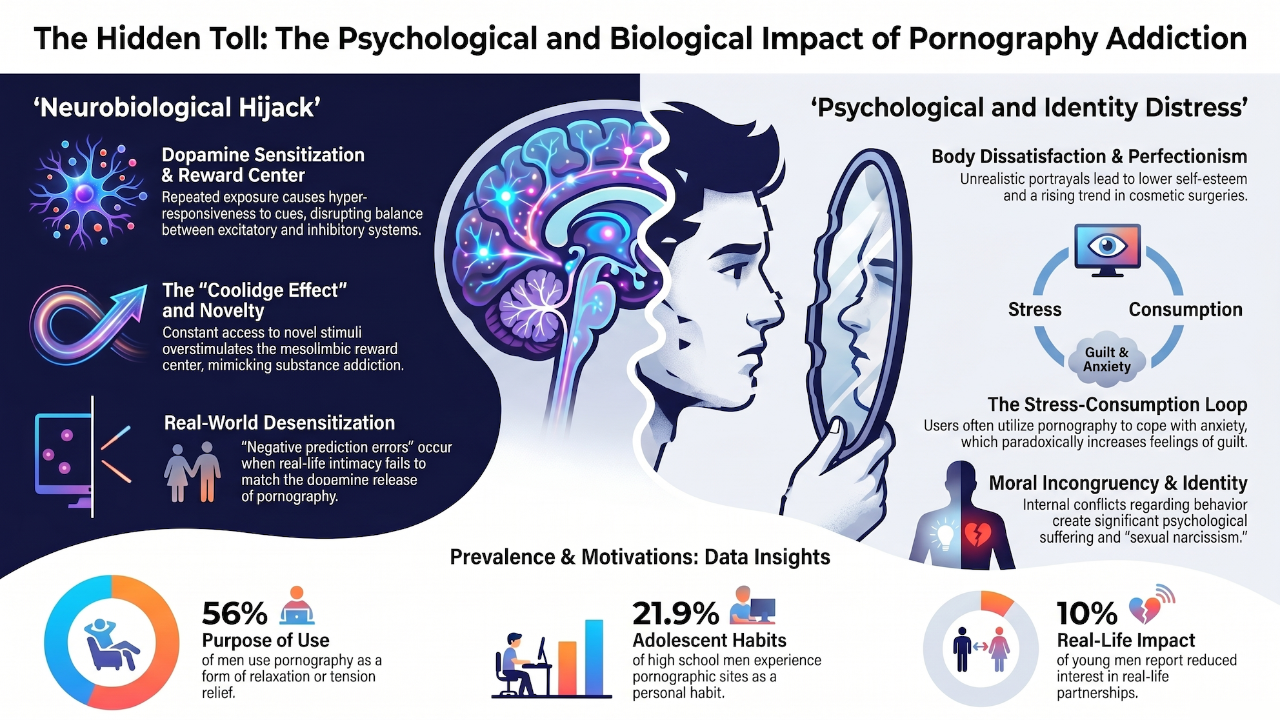
Here is something the research keeps confirming, and it matches what I hear in session after session. A lot of men do not start with pornography because they are chasing pleasure. They start because they are trying to cope. Stress. Loneliness. Pressure at work. A marriage that feels distant. A childhood that taught them not to bring their feelings to anyone. Pornography becomes a defense mechanism. A way to take the edge off. A way to regulate.
Privara and Bob put it like this:
"Internet pornography consumption might represent a defense mechanism against excessive stress, which enables to cope with stressful events, helps in mood regulation, and decreases depression and anxiety" (Privara & Bob, 2023).
Read that carefully. The research is not saying pornography is harmless. It is saying the brain learns to use it as relief, which is exactly what makes it sticky. If the nervous system finds a fast lever for relief, it will pull that lever again. And again. Especially if no one taught you a different lever. Roughly half of men using pornography describe it as a form of relaxation that decreases subjective feelings of tension (Privara & Bob, 2023, citing Cooper et al., 2004; Weiser, 2000).
But there is a second piece in the research that I do not want you to miss. Many of the men in those same studies report guilt. Internal conflict. A sense that they are doing something out of step with who they actually are. The authors describe it this way: users "reported that their self-exposure to pornographic material may create guilty feelings and internal conflict in themselves with respect to their own 'involuntary' sexual behavior" (Privara & Bob, 2023). That is not a weakness. That is your true self pushing back. That is the part of you that knows you were made for more than a screen. Do not silence that voice. That voice is the beginning of recovery.
The Brain Adapts. That Is the Whole Problem.
When we look at brain studies on compulsive pornography users, the picture is consistent. The reward system — the mesolimbic dopamine system, the same circuitry implicated in substance addiction — starts to respond differently. The cues become powerful. The novelty becomes powerful. And real life, by comparison, starts to feel a little muted.
Privara and Bob describe how repeated exposure changes the way arousal is processed:
"Repeated experiences of immense number of sexually arousing objects lead to long-lasting arousing emotional experiences that decrease usual mechanisms of 'habituation' and lead to very long periods of sexual arousal and sensitization to these stimuli" (Privara & Bob, 2023).
Think about it this way. The brain was built for novelty. It is part of how we are designed. Even animal research shows that mammals respond strongly to a new sexual partner — researchers call it the Coolidge effect (Fiorino et al., 1997; Wilson, 1997, as cited in Privara & Bob, 2023). It is biological. It is ancient. And the Internet weaponizes it. Endless novelty, on demand, with no relational cost. There is no human partner alive who can compete with infinity.
So what happens? Over time, the brain gets sensitized to the cues — even abstract cues, even non-sexual cues that are paired with use — and gets less responsive to ordinary life. Privara and Bob, summarizing Prause and Pfaus (2015), put it bluntly: "erectile problems may occur when real-life sexual stimulation does not match the broad content [accessible online]" (Privara & Bob, 2023). Erectile difficulties with a real partner, while functioning fine with pornography. Sexual interest in your wife is going quiet while your interest in a screen stays loud. That is not a character flaw. That is a learned neural pattern. And what is learned can be unlearned. But it takes a different process than telling yourself to try harder.
Loneliness Is the Engine. Not Lust.
I want to slow down here, because this is the piece that men miss most often. The research is very consistent on something that matches everything I see clinically — pornography use rises in conditions of disconnection. Privara and Bob note that consumption is highest among men who live alone or with their parents, particularly among young adult men (Privara & Bob, 2023, citing Cooper et al., 2000; Mauer-Vakil & Bahji, 2020; Ross et al., 2012; Wright, 2013). Developmentally, the authors point out that "adults with adverse stressful childhood experiences tend to have anxious attachment and sexual compulsion" (Privara & Bob, 2023, citing Aaron, 2012).
Read that again. Not lust. Disconnection.
We were made for relationships. The biology of attachment is not optional — it is the deepest design feature of being human. When the nervous system is in distress, it is looking for somewhere to go. Somewhere safe. Someone to soothe it. That is how God wired us, and it is how the research keeps describing us. If the safe somewhere is not there, the system will reach for whatever is closest. And what is closest, for a lot of men, is a phone.
So when I ask a client to track his urges, we are almost never tracking sexual hunger. We are tracking loneliness. We are tracking at eleven o'clock at night when the house is quiet. We are tracking the Tuesday afternoon when the meeting went badly, and he could not say it out loud to anyone. The urge is real. But the urge is mislabeled. The body is asking for closeness. It got trained, somewhere along the way, to ask for it in the wrong language.
Why It Makes You More Anxious and More Depressed
Here is the cruel loop the research describes. The use of pornography temporarily lowers stress and anxiety. So the brain learns — this works. Then, over time, the same use is associated with higher rates of depression, higher rates of anxiety, lower sexual wellbeing, and a deeper sense of moral conflict. Privara and Bob summarize the field this way:
"Stressful experiences, anxiety, and depression are strongly related to pornography consumption. In addition, conflicting emotional experiences as well as identity problems significantly increase vulnerability to addictive sexual behavior and pornography consumption" (Privara & Bob, 2023).
The very thing that calms you in the short term is feeding the thing it is supposedly calming. Why? Because every time you reach for the screen instead of a person, your attachment system loses a rep. Your capacity to be soothed by another human atrophies a little. Your sense of yourself as someone capable of real intimacy takes a hit. And the next time the distress comes, the only tool the body remembers is the one that has been quietly hollowing you out.
Add to that the moral piece. For men of faith, especially, there is an incongruency that the research has actually measured. Privara and Bob note that moral conflict around pornography is particularly pronounced "in individuals who declare their religious belief" (Privara & Bob, 2023, citing Grubbs et al., 2015; Perry, 2018; among others). When a man believes his sexuality is a sacred part of who he is, and his behavior keeps contradicting that belief, the resulting guilt is not neurotic — it is accurate. The answer is not to dismiss the guilt or to dial up the shame. The answer is to align the behavior with the belief, gently and over time, by retraining the nervous system to come home to real connection.
The Body Image Piece We Do Not Talk About Enough
There is another part of the research that I want to put on the table, because it affects more than the user. Sustained exposure to pornography shapes expectations — about bodies, about performance, about what sex is supposed to look like. Privara and Bob describe how pornography "places emphasis on physical perfection that few people can measure up to" (citing Mattebo et al., 2013), and connect this directly to increasing rates of cosmetic surgery in both young women and young men (Privara & Bob, 2023, citing Crouch et al., 2011; Marra et al., 2020). For young men, this can quietly distort how they perceive a real partner. For young women growing up under the cultural shadow of these images, it shapes how they perceive themselves.
I bring this up not to pile on, but because the men I work with often think their use is private and contained. It is not. The patterns we practice in private rewire how we see the people we love. Recovery is not just about you. It is about everyone in your life who gets to meet the version of you that is no longer outsourcing your nervous system to a screen.
What the Research Will Not Tell You
Here is what the research will not tell you. It will name the problem. It will describe the mechanisms. It will catalog the harms. What it will not do is sit next to you on a Tuesday night when the urge is high, and the house is quiet, and your wife went to bed three hours ago.
That part is the work of the community. Of a group of men who know your name and have your number. Of a therapist who is not going to flinch when you tell the truth. Of a faith that says you are loved before you are fixed and that the fixing is real. Privara and Bob themselves point in this direction, noting that "feelings of connectedness, bonding, and being listened to create an atmosphere of self-forgiveness and acceptance" and are inversely related to hypersexual behavior (Privara & Bob, 2023, citing Sniewski et al., 2018). That is a fancy way of saying — the antidote to compulsive use is being known. Slowly. Honestly. Over time.
You cannot think your way out of this. You cannot shame your way out of this. You cannot white-knuckle your way out of this. You have to be reached for, and you have to learn to reach back.
If You Are Reading This and You Are Tired
If you are reading this and you are tired — tired of the cycle, tired of starting over, tired of the gap between who you want to be and what you keep doing — I want you to hear something. The research is on your side. Your nervous system is not broken. It is doing exactly what it learned to do. And it can learn something else.
The way out is not louder willpower. The way out is slower, and stranger, and quieter than that. It looks like learning to notice the urge rather than obey it. It looks like reaching for one safe person instead of a screen. It looks like a few men in a room, on a Wednesday night, telling the truth about the week. It looks like a faith that has room for the whole of you, including the part that has been hiding.
If you want help, we do this work every week at Arizona Family Institute. You do not have to come in ready. You just have to come in. The rest, we will figure out together.
Reference
Privara, M., & Bob, P. (2023). Pornography Consumption and Cognitive-Affective Distress. The Journal of Nervous and Mental Disease, 211(8), 641–646. PMCID: PMC10399954.
Don't miss a beat!
New moves, motivation, and classes delivered to your inbox.
We hate SPAM. We will never sell your information, for any reason.
