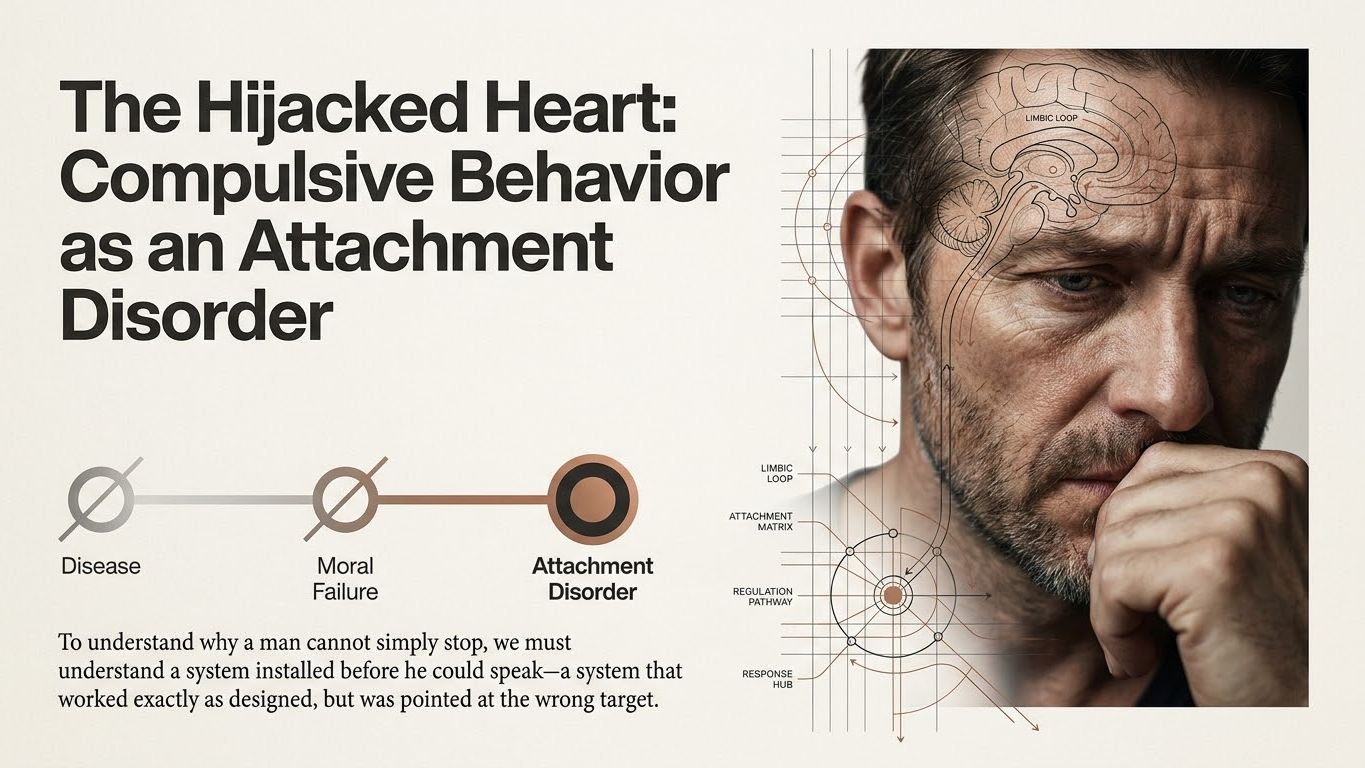
Why Addiction Is an Attachment Disorder: The Science of a Hijacked Nervous System
Jun 11, 2026By Dan Oakes, MEd, LPC, CSAT — Arizona Family Institute
Is pornography addiction a disease? Is compulsive sexual behavior a brain disorder, a moral failure, or something else entirely? Why does a man keep returning to a behavior he genuinely hates — one that violates his own values, costs him his marriage, his sleep, his self-respect — and still go back again tonight? These are the questions men carry into my office, usually after years of fighting alone. And the answer that actually fits the evidence is not the one most of them have been handed.
Compulsive behavior is not, at its root, a disease of the brain. It is a disorder of attachment. To understand why a man can't simply stop, you have to understand a system installed in him before he could speak, that worked exactly as designed, and that was pointed at the wrong target. This post is only about that — the why. Not what to do about it. Just the mechanism, laid out as honestly as I know how, because in my experience the understanding itself is where the shame finally starts to loosen its grip.
The system was installed before you had words for it
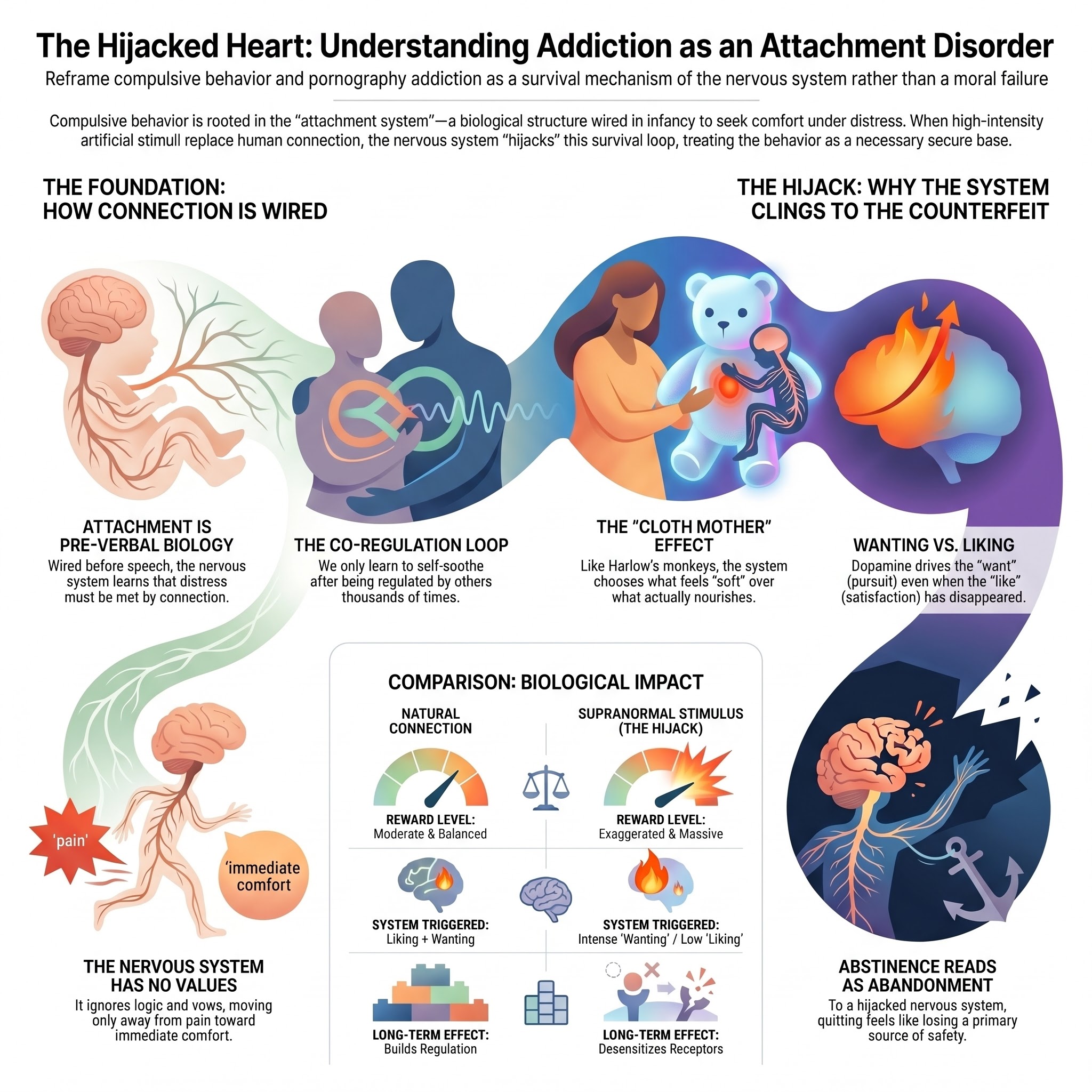
Start at the beginning. A baby is born, and the first thing it does is cry. And the first thing that happens — if things go reasonably well — is that it gets soothed. Skin against skin. Warmth. The mother's heartbeat. Milk. And in that first exchange, something gets wired in: when I am in distress, I cry, and connection comes. Somebody answers.
Here's the part that matters clinically. That learning doesn't happen in the brain's thinking part. It happens in the right hemisphere, which develops first and dominates for roughly the first three years of life. The research on this is well established — the developmental neuroscientist Allan Schore has spent decades documenting how the infant's early-maturing right brain, deeply wired into the limbic and autonomic nervous systems, is shaped by these earliest emotional exchanges with a caregiver. It's pre-verbal. It's a felt sense, not a thought. You don't remember learning it, any more than you remember learning to want air. It's stored below language, in the body, in what gets called implicit or procedural memory.
So before a child can name a single feeling, the architecture is already there: distress reaches outward for a person, and a person regulates the distress. That's the attachment structure. It is not a preference. It is biology.
It matures into a secure base — and then it never leaves
By around age two, the structure gets more sophisticated. Picture a parent baby-proofing a living room. Why? So the child can explore. And the child does — crawls off, gets into things, ventures to the far corner of the room. Until he falls, or gets startled, or the distress gets too big. And then he turns and runs straight back to mom or dad, gets soothed, and within a minute is back out exploring again.
That little loop is the whole thing. Explore, hit distress beyond what you can manage, return to the secure base, get regulated, launch back out. We call the regulating part co-regulation, and here's the clinical truth underneath it: no human being learns to regulate himself without first being regulated by someone else, thousands of times. The capacity to self-soothe — what we call auto-regulation — is built entirely on a history of having been soothed. An infant can only co-regulate. The self-soothing comes later, and only because the co-regulation came first.
And the structure doesn't expire when you grow up. This is the part I want to land. You get more independent, you can hold your own distress longer, you can stay regulated on your own for stretches that would have been impossible at age two. But the need to return to a secure base never goes away. It only changes address. It moves from parents to friends, from friends to a spouse, and ideally you also learn to be a secure base for yourself. But under real distress, the nervous system still asks the same question it asked in the crib: where do I go? You cannot take that out of a human being. It's in the soul.
The nervous system has no values — it only moves toward comfort
Now here's the mechanism that makes addiction make sense. And it's the piece almost nobody explains.
Your nervous system doesn't learn. Not really. The brain learns — the brain holds your values, your beliefs, your sense of who you want to be. The nervous system is simpler and far more ancient than that. It does one thing: it moves away from discomfort and toward comfort. That's it. It has no opinion about whether the comfort is good for you. It has no idea what your marriage vows say. It is not consulting your faith or your goals. It registers distress and reaches for whatever has reliably made it stop.
In a healthy design, what stops the distress is connection — and the natural channels for that connection are human relationships, food, and physical intimacy. Notice that all three were fused together in that very first soothing experience at the breast: nourishment, touch, and another human being, arriving as one event. That's not an accident. Those are the body's designed sources of comfort, and what they share is that the reward is moderate and it comes bundled with another person.
The neuroscience here sharpens the picture. For a long time dopamine was called the brain's "pleasure chemical." That turns out to be wrong, and the correction matters enormously for understanding addiction. The University of Michigan neuroscientist Kent Berridge has shown across decades of work that dopamine doesn't actually produce pleasure — what he calls "liking." Dopamine produces wanting. It's the chemistry of pursuit, craving, the pull toward a thing — what researchers call incentive salience. Liking and wanting are run by different systems in the brain, and they can come apart.
Sit with that, because it's the whole tragedy of addiction in one sentence: you can be driven to want something you no longer even like.
The hijack: a counterfeit more stimulating than the real thing
So the attachment system is humming along, pointed at the natural targets, when something stronger walks in.
The nervous system reaches for whatever most reliably and most powerfully relieves distress. And the modern world is full of things engineered to relieve distress more quickly and more effectively than a relationship ever could. Video games. Social media. And, most powerfully, pornography. Biologists have a name for this. They call it a supranormal stimulus — a term coined by the Nobel laureate Nikolaas Tinbergen, who found that animals would prefer an artificial, exaggerated version of a natural cue over the real thing. The butterfly that chases a too-bright cardboard model instead of a living mate. Researchers like Donald Hilton have argued that internet pornography functions as exactly this kind of supranormal stimulus for the human reward system — endless novelty, unlimited and exaggerated, producing a dopamine surge that no actual partner, no actual meal, no actual conversation can match.
And here's where the wanting-versus-liking distinction does its damage. The supranormal stimulus floods the wanting system with dopamine — an enormous pull — while delivering a hollow version of the liking. So the man gets driven toward it harder and harder, while the actual satisfaction thins out over time. The brain, flooded repeatedly, adapts the only way it can: it turns down its own sensitivity, desensitizes its receptors. Which means the natural rewards — a good dinner, a real conversation, intimacy with his wife — start to register as flat, not enough, barely worth the effort. The counterfeit gets louder while the real thing goes quiet.
Do this enough times under distress, and the attachment structure completes its capture. The compulsive behavior stops being a thing he does and becomes the place he goes. It relegates itself, quietly, into the seat where a secure base is supposed to sit. And this is why it almost never feels like an addiction from the inside. It feels like a bad habit. He doesn't experience it as "my attachment system has been hijacked by a supranormal stimulus." He experiences it as "I don't know, I just keep doing this stupid thing." But underneath, his nervous system has filed pornography under the same heading where it once filed his mother's arms: this is where I go when it hurts.
The system can't tell the counterfeit from the real thing
There's a cruel feature built into this. At the level where the hijack lives — the limbic, pre-verbal level — the system genuinely cannot distinguish a real person from an image of one. To the old machinery, a screen full of bodies registers as connection, as abundance, as people. The thinking brain knows better. But the thinking brain isn't driving at 11 o'clock at night. The reckoning only comes the next morning, when the higher brain comes back online and surveys what happened and floods him with the emptiness and the shame. Which, as we'll see, is the very thing that drives the next cycle.
The classic attachment research makes this almost unbearably clear. In the 1950s, Harry Harlow gave infant monkeys a choice between two surrogate mothers: one made of bare wire that dispensed milk, and one made of soft cloth that gave no food at all. Behaviorism at the time predicted the babies would bond with the wire mother, because she fed them. They didn't. They clung to the cloth mother almost around the clock and went to the wire mother only briefly, to feed, before scrambling back to the soft one. When something frightening was introduced, they ran to the cloth. Attachment didn't form around what nourished them. It formed around what felt safe and soft.
The compulsive behavior is the cloth mother. It's the fake mama. It gives no nourishment — it can't love him back, can't see him, can't actually regulate his nervous system in any lasting way. But it's soft, and it's there, and it asks nothing of him, and so the system clings to it. A man can starve for real connection while clinging, every night, to the thing that gives him none of it.
Why willpower fails: abstinence reads as abandonment
Now you can see why the standard advice — just stop, white-knuckle it, count your sober days — so reliably collapses.
When a man tries to quit by sheer force, he's not just removing a behavior. He is removing, without replacement, the thing his nervous system has been treating as its secure base. He's pulling away from what the deepest part of him experiences as connection. And the system does exactly what an infant does when the secure base disappears: it panics. It protests. It floods him with urgency, with that I-need-something pressure that feels far bigger than the situation should warrant. From the nervous system's perspective, this isn't self-improvement. It's abandonment.
That's why the relapse so often lands right before the goal — on day twenty-nine of a thirty-day commitment. It looks like self-sabotage. It isn't. It's the protest peaking as the isolation stretches longer than the system can tolerate. And then comes the cruelest turn of the whole machine: he slips, and the thinking brain comes back and says You failed, you're weak, what's wrong with you. That shame is itself a profound experience of disconnection — from himself, from God, from the people he loves. And disconnection is distress. And distress is precisely the trigger that sends the nervous system reaching, again, for the thing it has filed under comfort. Shame doesn't interrupt the cycle. Shame is the fuel of the cycle. The loop closes and feeds itself.
So the urge itself, properly understood, is not the enemy and not even really about sex. It's a misread signal. Lonely first, hungry second. The body is reaching for connection, and the hijacked pattern simply answers the phone before a person can.
The deepest cost: the wanting to connect goes quiet
There is one more finding I have to share, because it names the real stakes, and because it haunts me a little.
Researchers at the University of Chicago — Inbal Ben-Ami Bartal, Peggy Mason, and Jean Decety — ran a now-famous experiment. They put a rat in an arena with a cagemate trapped in a small restrainer. With no training and no reward, the free rat learned to open the door and free its trapped companion. It did this reliably, urgently. And when they gave the rat a choice between freeing its cagemate and a pile of chocolate, the rat valued freeing its friend roughly on par with the chocolate — it would free the other rat and share the treats. The drive to relieve another's distress was that deep, that built-in.
Then, in a follow-up study, they gave the free rats midazolam — an anti-anxiety drug, a benzodiazepine. And the helping stopped. The drugged rats no longer freed their trapped companions. But here is the detail that should stay with you: those same drugged rats still opened the restrainer when it held chocolate. The skill was perfectly intact. The ability was untouched. What was gone was the caring. Quite the distress that makes another's suffering register, and the desire to connect simply evaporates — while the capacity to go get the reward remains.
That is a picture of what prolonged compulsive behavior does to a man. Stay in the hijack long enough, and it doesn't just occupy the attachment seat — it mutes the very desire to connect. The skill to reach for people is still in there somewhere. But the wanting goes quiet. And the connection skills, unused, atrophy. I've sat with men who say it plainly without knowing what they're describing: I look at porn, so I don't think I deserve to date. And the tragedy is that the nervous system still demands connection — it always will, it can't — so when the desire for real people goes quiet, that demand doesn't disappear. It just diffuses into whatever pattern is closest. The porn. The food. The scrolling. The work. Anything that sits in the seat.
What this means
If you've read this far, maybe you can feel the reframe settling in. The question was never really, "What's wrong with me that I can't stop?" The question underneath was always what is this behavior doing for me — what is it standing in for? And the answer, every time, is connection. A counterfeit, supranormal, hollow connection that the oldest part of you mistook for the real thing, for understandable reasons, a long time ago.
This isn't an excuse, and it isn't a diagnosis that lets anyone off the hook. It's just the truth of the mechanism. And I've watched what happens when a man finally understands that the part of him driving the behavior isn't evil or broken — it's a survival system, working exactly as designed, that got pointed at the wrong thing. Something in him exhales. The shame, which was never anything but more fuel, gets a little quieter.
That exhale is where the real work begins. But that's another conversation.
If this stirred something up and you're carrying it alone, you don't have to. That's what we're here for.
Don't miss a beat!
New moves, motivation, and classes delivered to your inbox.
We hate SPAM. We will never sell your information, for any reason.
