The_Architecture_of_Belonging: Why Don't I Have Friends Anymore?
Jul 15, 2026by Dan Oakes MEd LPC
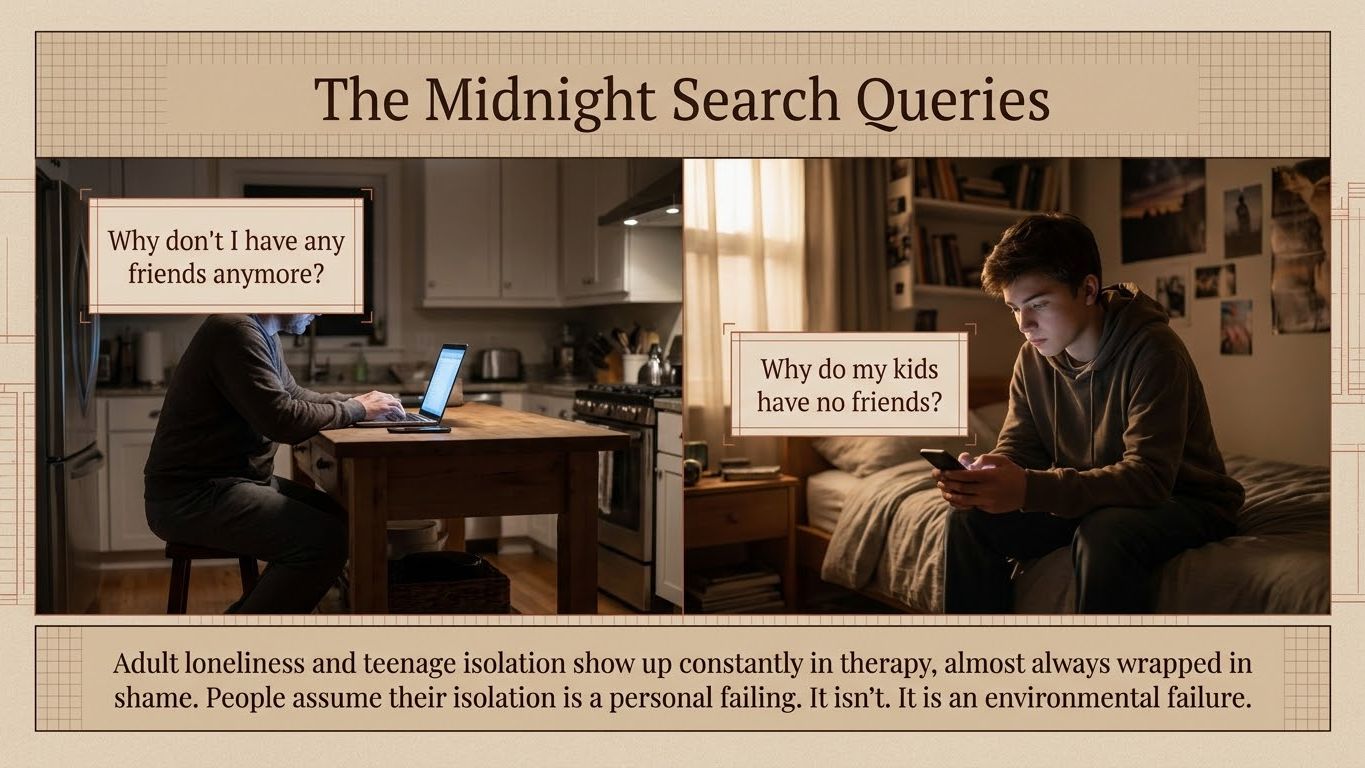
If you've ever typed why don't I have any friends anymore into a search bar late at night — or watched your teenager vanish into a screen and wondered why do my kids have no friends — you're asking one of the most common questions I hear as a therapist here in Mesa, Arizona. Adult loneliness, teenage isolation, the slow disappearance of real community: these show up in my office constantly, and almost always wrapped in shame. People assume it's a personal failing. I want to make a case that it isn't. It's an environmental one — and understanding the difference changes everything about what you do next.
Because I grew up in a town where you ran into people.
Not on purpose. That was the point. You'd go to the hardware store for a hinge and you'd end up talking to somebody's dad for twenty minutes about nothing at all, and neither of you had planned it, and neither of you resented it. That was just what a Saturday was.
I don't think I understood I was being fed by that until it was gone.
Third places
Urban planners have a term for it. The third place.
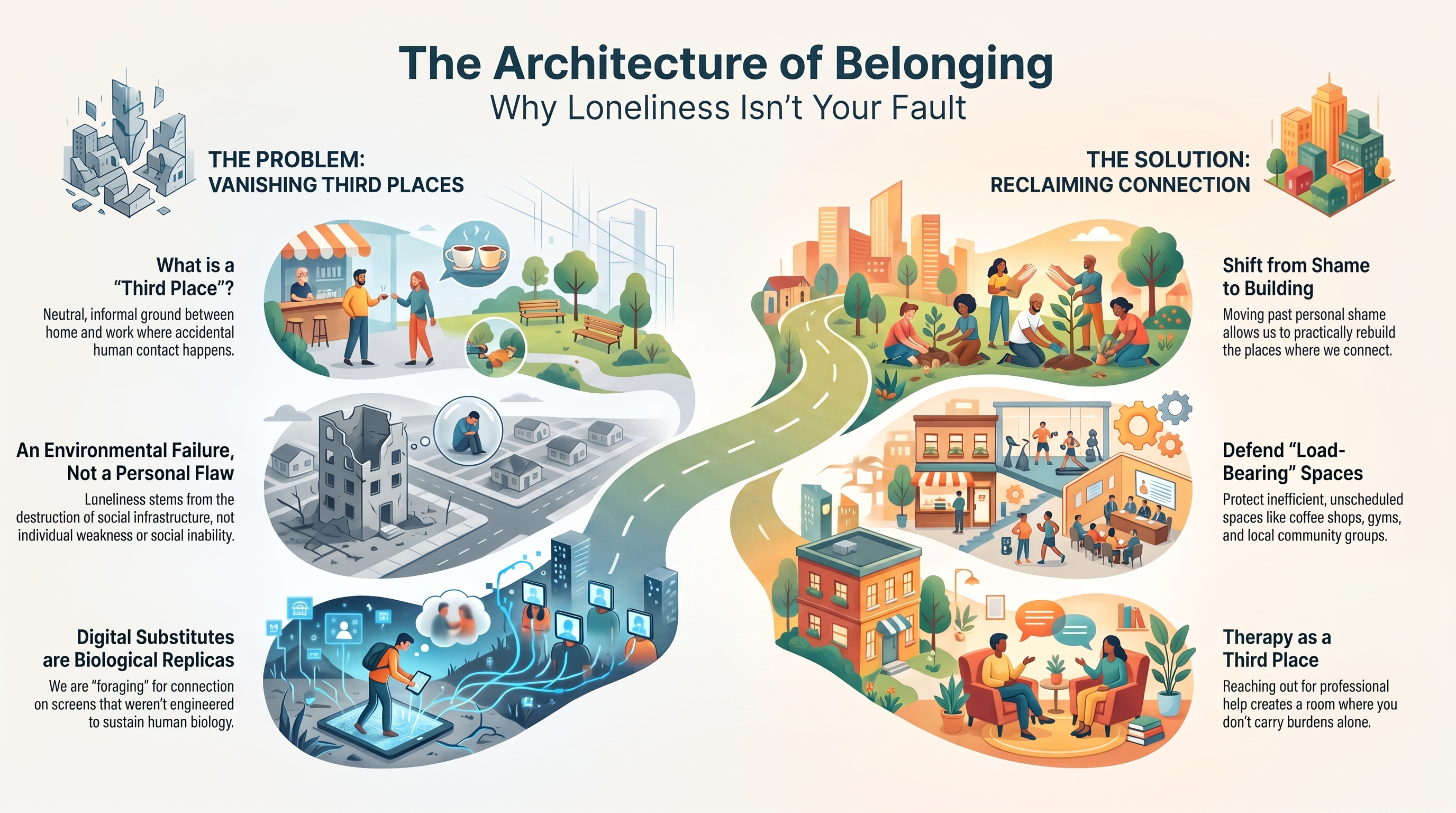
Not home. Not work or school. The third one. The neutral, informal, low-stakes ground where you encounter people you did not schedule an appointment to encounter.
The diner. The barbershop. The bowling alley. The coffee bar where the same six people are always there at the same hour. The church parking lot after the meeting ends, where nobody's in a hurry to leave.
Third places are not amenities. They are infrastructure. They're the physical architecture of belonging — built, whether anyone meant to or not, to produce accidental human contact between neighbors.
And starting in the seventies, we took them apart.
Some of it was zoning. Some of it was economics — the local venue can't make rent, the corner spot becomes a chain, the chain becomes a drive-through, the drive-through becomes nothing. Some of it was a cultural turn toward hyper-individualism that made the whole idea of a lingering, unproductive, unscheduled conversation feel like a waste of a perfectly good afternoon.
We optimized. And the places where people met each other for no reason at all did not survive optimization.
The migration was not a moral failure
Here's what I need people to hear, because it changes everything about how we respond.
When those places vanished, the need did not vanish with them.
The hunger for community is not a preference. It's biology. It's as fundamental as hunger for food. So when the physical architecture came down, a whole generation did exactly what any organism does when its environment stops providing something it needs to live.
They went looking.
And what was there, waiting, endlessly available, free, glowing — was a digital substitute that was never engineered to sustain human biology. Not built for it. Not designed for it. Not even really trying.
We stripped away the real thing and left a replica in its place, and then we turned around and told young people they were addicted, weak, coddled, glued to their screens.
They were foraging.
What this means for the way we help
When I understand loneliness as an environmental failure rather than a personal flaw, my whole clinical posture changes.
I stop asking, what's wrong with you that you can't connect?
I start asking, where did they take the places you would have connected in — and what can we build back?
This isn't a small distinction. The first question deepens shame, and shame drives people further into isolation, and isolation drives the very behaviors we're trying to address. I see this loop constantly in my work with men who've lost themselves in compulsive behavior. Shame doesn't produce connection. Shame produces hiding.
The rebuilding is slower than the tearing down
I don't have a policy solution for you. I'm a therapist, not an urban planner, and I'm suspicious of anyone who promises that a systemic problem has a tidy personal fix.
But I'll say this. The third places that are left are worth defending. The ones that still exist — the ward building, the gym at six in the morning, the coffee shop where the barista knows your order, the men's group that meets on the first and third Monday whether you feel like it or not — those are load-bearing.
We're always tempted to skip them. They're inefficient. They cost time and produce nothing.
That's precisely what they're for.
If you're carrying this alone
And if you've read this far because it's landing close to home — because the loneliness is yours, or your kid's, or your marriage's — I want you to know it's not something you have to sort out by yourself. That's the whole point of everything I just wrote.
At the Arizona Family Institute in Mesa, my team and I work with individuals, couples, and families on exactly this: the disconnection that hides underneath so much anxiety, so much compulsion, so much quiet despair. Reaching out for help is itself a kind of third place — a room where you don't have to carry it alone. If you're ready, or even just wondering, we'd be glad to hear from you.
📍 Arizona Family Institute — 2500 S. Power Rd., Suite 120, Mesa, AZ 85209 - 480-382-1257
Don't miss a beat!
New moves, motivation, and classes delivered to your inbox.
We hate SPAM. We will never sell your information, for any reason.
