One Up, One Down: The Quiet Collapse of Connection
Apr 16, 2026by Chrystal Bowman LMFT
"Sure, babe. Whatever you want."
I've heard that sentence in my office more times than I can count. And most of the time, the partner saying it isn't really fine. They're tired. Or done. Or so far down inside themselves they don't even know what they'd want if you asked. ( see my video on this topic )
The partner across from them usually doesn't notice. Or doesn't want to.
That's what I want to talk about today. Not who wears the pants. Not the usual arguments about control. Something quieter than that. Something that sneaks up on couples over years.
One up, one down
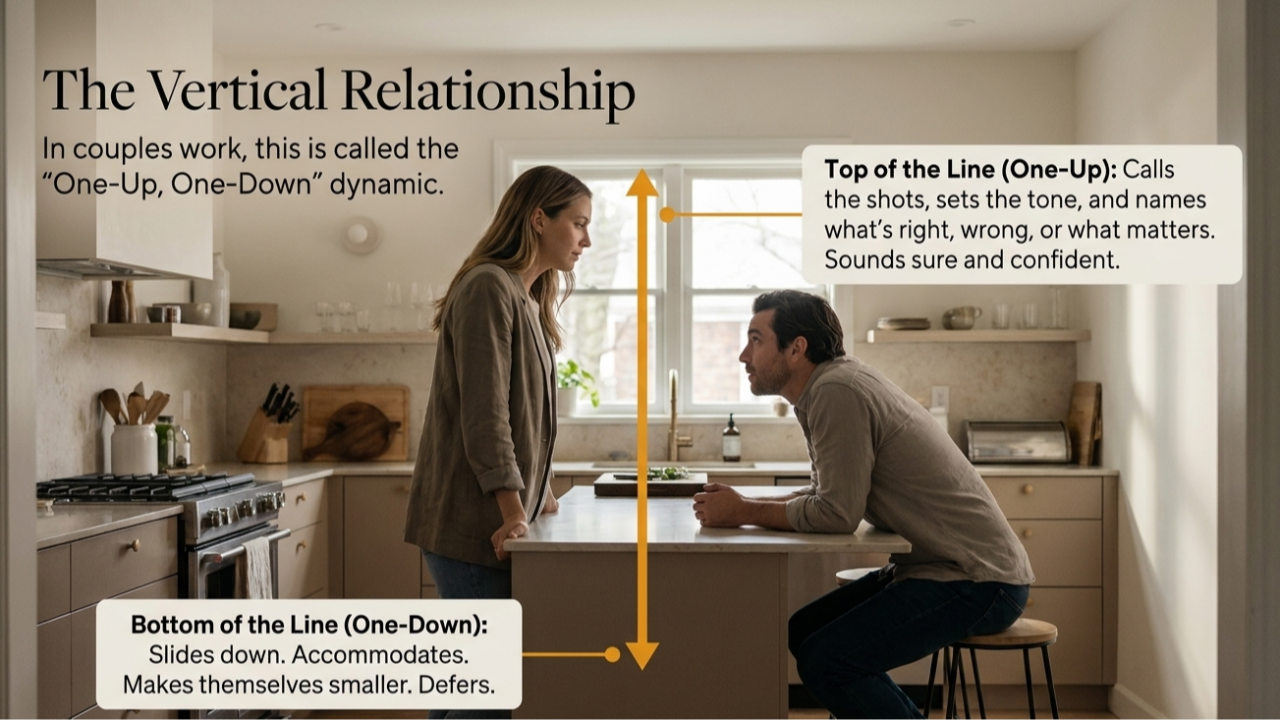
In couples work we sometimes call it a one-up, one-down dynamic. One of you ends up calling more of the shots — setting the tone, naming what's right, what's wrong, what matters. The other one slides down. Accommodates. Makes themselves smaller. Defers.
The one-up partner tends to sound sure. Confident. Which is fine, except when it tips into critical, or dismissive, or what's wrong with you. Sometimes that's said out loud. More often it lives in a sigh, or the silence after someone shares something vulnerable and it just… lands on the floor.
The one-down partner sounds different. It's not a big deal. Whatever you think. I'm just tired.
Here's where I want to stop for a second.
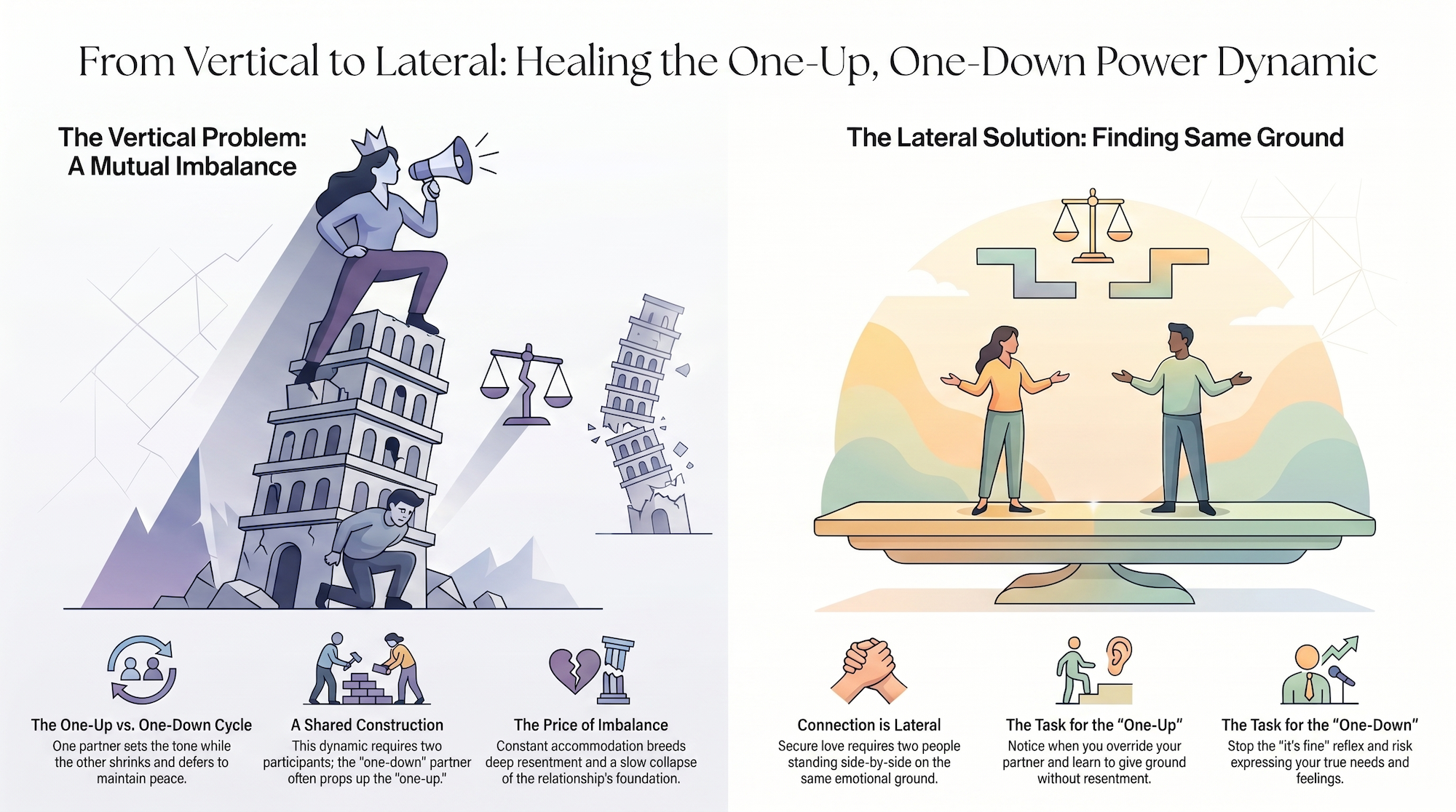
It is a big deal. When one person in a relationship keeps adapting to the other — over and over, for years — that's not being easygoing. That's not collaboration. That's an imbalance. And imbalances breed things. Resentment. Distance. A slow collapse of the relationship, and honestly, a slow collapse inside the person who's been doing all the shrinking.
I've watched people live like this for twenty years before they finally blew up. Or just quietly walked out one Tuesday afternoon.
Both of you built this
Okay. Here's the hard part.
One-up can't exist without one-down. The whole thing requires two chairs. The partner in the lower seat isn't just something happening to them — they're part of what keeps it running. Usually for reasons that make sense. Old attachment stuff. A fear of conflict they learned somewhere a long time ago. A quiet belief that love has to be earned by being agreeable.
I say that gently. I'm not trying to hand you more shame.
I'm saying it because I've watched too many people stay stuck by pointing only at their partner. If they would just… And I get it. It feels safer to locate the problem over there. But it also keeps you powerless in your own marriage.
The one-down props up the one-up. That's just how the dynamic works. And until somebody names it, nothing really moves.
It's not who you are. It's what you built.
The other thing that makes this hard to see — it's not a personality trait. It's not that one of you is a dominant person and one of you is a passive person. It's something that gets created between two people.
Which means it can flip depending on the context.
I've worked with couples where the husband is clearly one-up around money, decisions, the calendar — and then the second we start talking about the kids, the whole thing flips. Now she's in charge. Now he's the one going okay, whatever you think, you know them better.
And look, the specific arrangement doesn't really matter. The problem isn't who's on top in any given area. The problem is that you've built a relationship where somebody almost always has to be on top for things to feel okay.
Connection doesn't live there.
Connection is lateral
Attachment science says this clearly, and every good hour I've had in the therapy room confirms it — connection happens laterally. Side by side. Two people on the same ground, who can disagree, who can want different things, who can bring their whole separate selves to the table without one of them having to collapse or take over.
That's what secure love actually looks like. Not matching. Not always agreeing. Lateral.
The one-up, one-down thing is the opposite of that. It's vertical. And vertical is where connection suffocates.
What honest work looks like
If you're reading this and you already know which chair you tend to sit in — just stay there for a minute. Don't rush past it.
If you're the one-up, the work is hard in a particular way. It's noticing how often you take over. How often you correct, or override, or decide before your partner's finished talking. It's asking yourself what you're actually afraid of when they have a different opinion than yours. It's learning to give ground without resentment.
If you're the one-down, the work is hard in a different way. Maybe harder. It's stopping the it's fine reflex. It's letting yourself feel the quiet anger that's been sitting underneath all that accommodation. It's risking a sentence like actually, this does matter to me — and then staying in the room while your partner has to adjust.
Neither of you is the villain here. You built this together, probably without ever meaning to. And you'll have to build something else together too.
One more thing
Most couples don't end up here because they stopped loving each other. They end up here because at some point the seats they took felt safer, or more familiar, or just easier. Maybe one of you grew up accommodating to survive. Maybe the other grew up needing to be in control to feel okay. Maybe you were both doing the best you could with what you had.
But the seats you took aren't the seats you have to keep sitting in.
So this week, I'd just ask you to notice.
Who decides what you do on Saturday. Who gets their way more often. Who says it's fine a little too fast. Whose voice fills the room at dinner and whose voice kind of disappears.
Don't fix it yet. Just see it.
That's where the work starts. And honestly — that's where finding each other again starts too.
Same ground. Side by side. The place connection actually lives.
Don't miss a beat!
New moves, motivation, and classes delivered to your inbox.
We hate SPAM. We will never sell your information, for any reason.
