
Sophisticated Empathy & Betrayal Recovery | AFI
Apr 09, 2026Most men I work with are not unfeeling people.
That's the thing that gets lost in the narrative around betrayal. The guy who lied, who hid the addiction, who deceived his partner for months or years — people assume he must be cold. Incapable of real empathy. A narcissist, maybe. (see my video on this topic here)
Sometimes. But more often, not.
What I find, sitting across from these men week after week, is something more complicated and honestly more heartbreaking. They can feel. They just can't get out of their own way long enough to feel the right things.
There's a concept I keep coming back to in this work. It's called sophisticated empathy.
Basic empathy — most of us have access to that. You can understand intellectually that someone is hurting. You can feel a general sadness that they're in pain. You might even tear up. That's real, and it's not nothing.
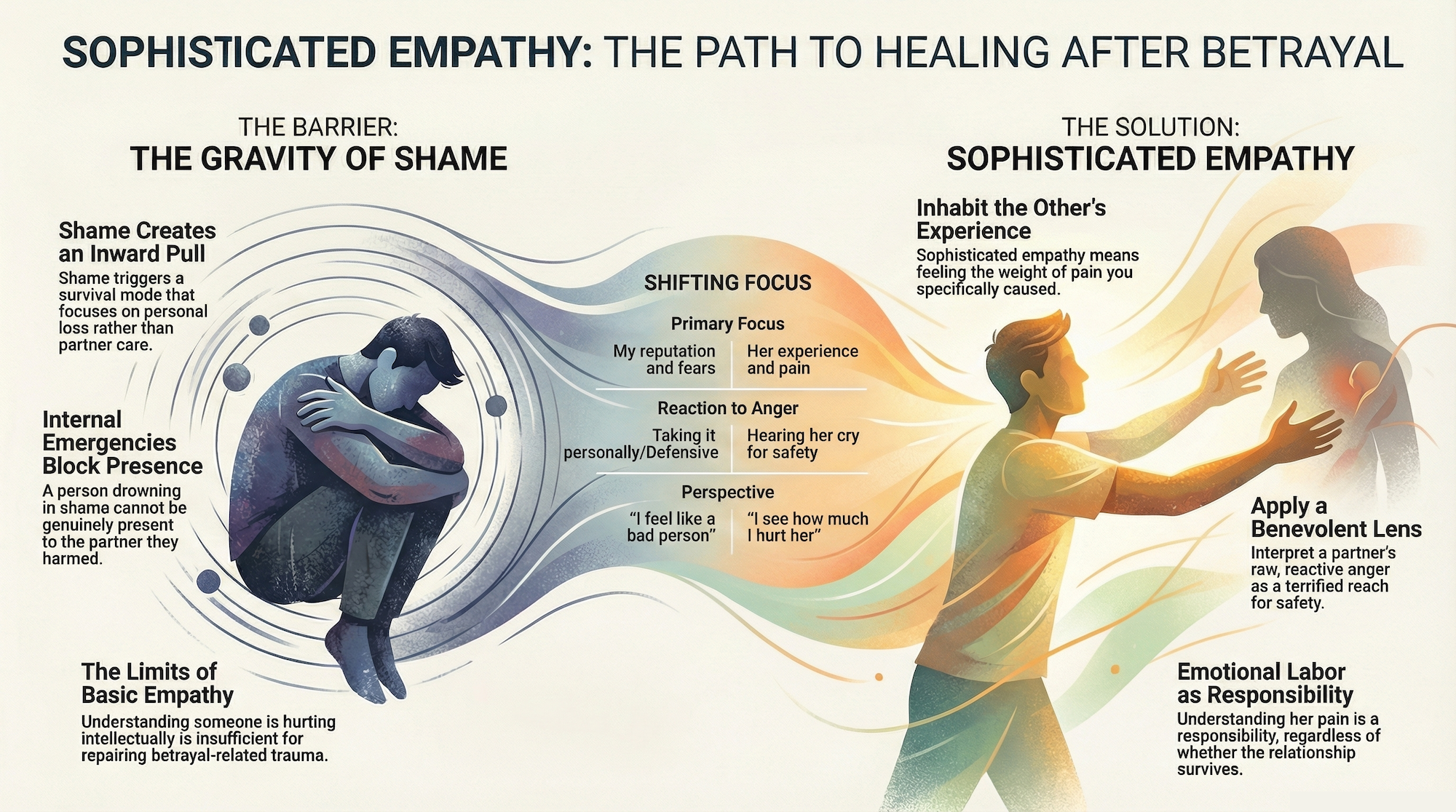
But sophisticated empathy is something different. It's the capacity to actually inhabit what the other person is experiencing — to feel the weight of it, to care deeply about it — even when you are the one who caused it. Especially when you are the one who caused it.
That's a high bar. And it's the bar betrayal repair actually requires.
Here's what gets in the way.
In the early stages of disclosure and discovery, the men I work with are drowning in shame. They feel horrible about themselves. They're terrified of what they stand to lose — their marriage, their reputation, their kids' perception of them. There's this enormous gravitational pull inward. Everything becomes about me. What I'm feeling. What I stand to lose. How bad I feel about what I did.
And I want to be clear — that's understandable. It's human. Shame does that. When your self-esteem is depleted, when you feel genuinely worthless, the nervous system contracts. There's not space for generous, outward-facing care. You're in survival mode.
But here's the clinical reality: a man in shame cannot offer sophisticated empathy. He's too busy managing his own internal emergency to be genuinely present to the person he harmed.
And the betrayed partner — she can feel that. She may not have language for it, but she knows. Something is off. He's crying, he says he's sorry, but it still feels like it's about him.
Because it is.
There's another piece that makes this harder. When a betrayed partner is in the acute stage of pain, she is not going to communicate in polished, measured sentences. She's going to be raw. Reactive. Sometimes sharp. Sometimes incoherent from grief. The words may come out sideways.
And what I see the men do — almost universally, at first — is take it personally. They hear her tone, her anger, her desperation, and they respond to the surface of it. They get defensive. They start managing her emotion instead of receiving it.
What they need to learn to do instead is interpret her with the most benevolent lens possible. To hear underneath the words and ask: What is she actually trying to communicate?
Almost always, the answer is some version of: You hurt me. I need to know you actually understand how much. And I need to believe you won't do this again.
That's not an attack. That's a terrified person reaching for some kind of safety.
When a man can hear it that way — when he can stay in a patient, caring, genuinely curious posture even when it's uncomfortable — that's sophisticated empathy in practice. That's the moment she starts to wonder, maybe for the first time, whether this relationship could ever feel safe again.
I want to say something to the men who might be reading this.
This work is hard. I'm not minimizing that. Sitting in the full weight of what you've done to someone you love, without deflecting into shame or defense, without making it about you — that's some of the hardest emotional labor a person can do.
But it's yours to do. Not because you're being punished. Because you caused the harm, and to whatever degree your presence and genuine understanding can help her heal — that's on you. That's your responsibility and, if you're willing to see it this way, your opportunity.
Even if the relationship doesn't survive. Even if there's no reconciliation at the end of this road. She deserves to have someone look her in the eye and truly get it.
That's sophisticated empathy.
And it might be the most important thing you ever learn to do.
Don't miss a beat!
New moves, motivation, and classes delivered to your inbox.
We hate SPAM. We will never sell your information, for any reason.
