When the Floor Gives Way: The First Phase of Healing from Betrayal Trauma
Apr 25, 2026By Jeni Steele, LPC — Arizona Family Institute
You find out.
Maybe it was a phone left open on the counter. A receipt. A friend who finally said something. Or maybe your partner sat you down and told you themselves. However it happened, there is a moment — and after that moment, nothing feels the same.
In my office, I see this look on people's faces all the time. It's not just sadness. It's not just rage. It's something more disorienting than either of those. People will sit on my couch and say, "I don't even know what's real anymore." And I'll nod, because I know exactly what they mean. ( see my video on this topic )
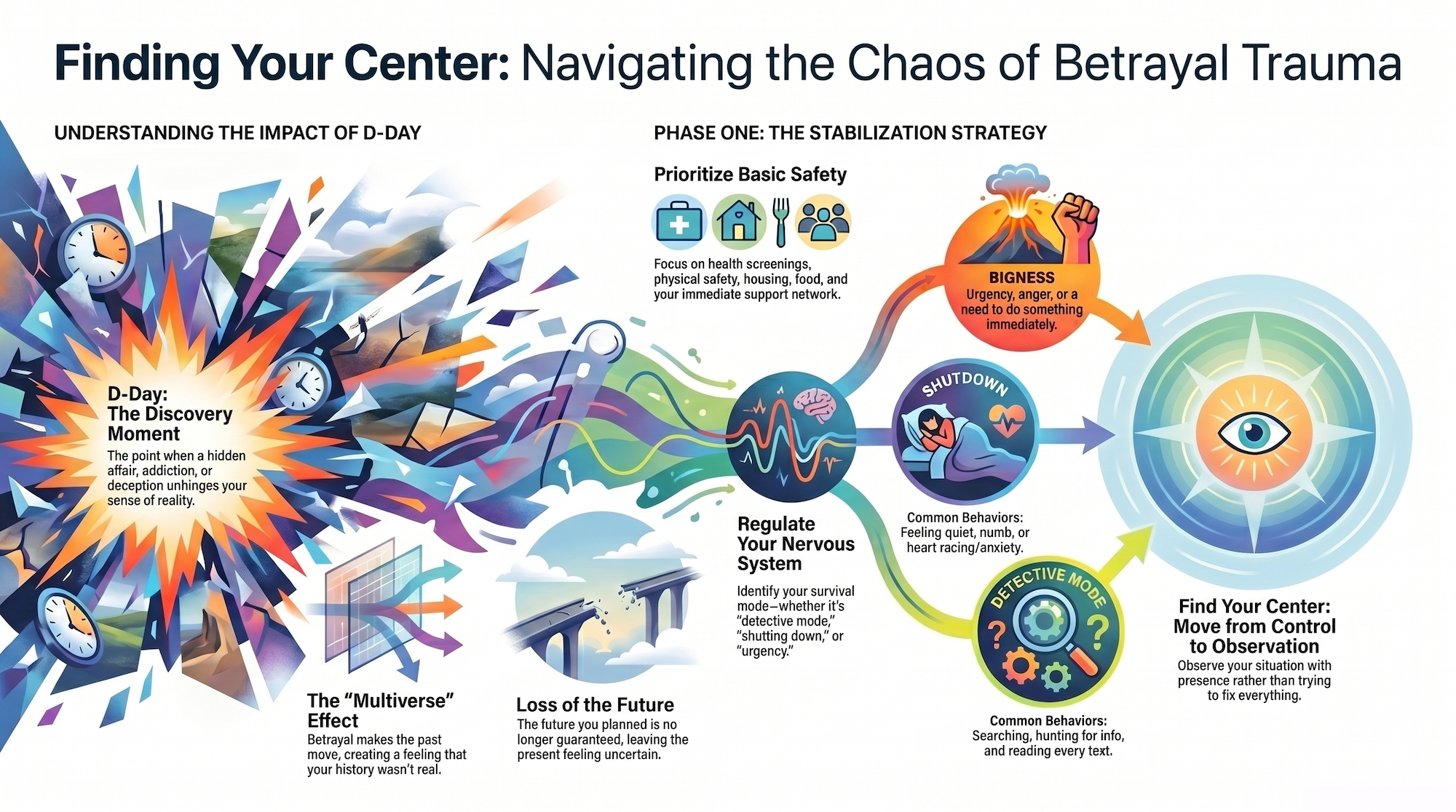
In our world, we call that moment D-Day—the discovery day. The day a betrayal — an affair, a hidden addiction, a pattern of deception, some other intimate breach — comes to light. And what happens after D-Day is not a clean grieving process. It's chaos.
I want to talk to you about that first phase. The chaos and discovery phase. Because if you're in it right now, I want you to know two things: what's happening to you makes sense, and there is a way through.
Why Betrayal Hurts the Way It Does
I'm Jeni. I'm a Licensed Professional Counselor, and a lot of my work is with people who've experienced relational or intimate betrayal — a spouse, a partner, someone of real significance.
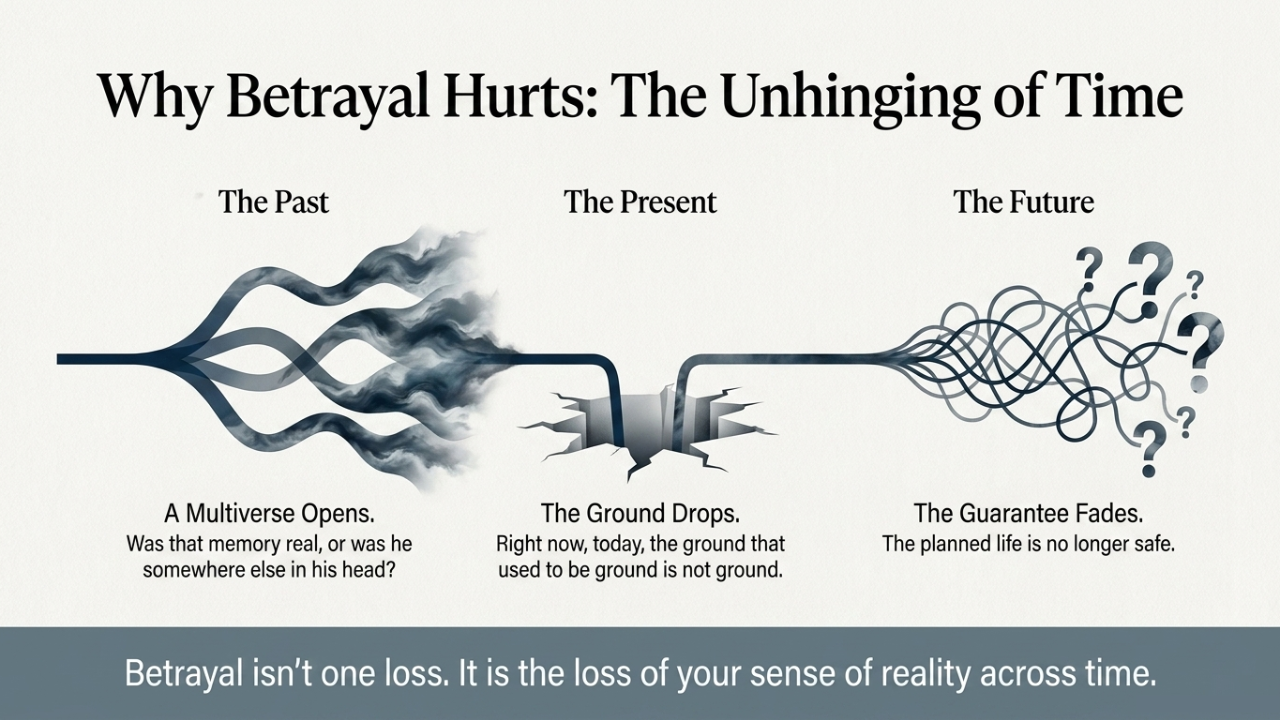
Here's how I describe what betrayal does: it unhinges everything you knew about the past.
We usually think of the past as set in stone. It's the one thing we're sure of. It already happened. But when you find out that the story you were living wasn't the actual story — that there was another timeline running underneath yours that you didn't have access to — suddenly the past starts moving. It's like a multiverse opens up in your own mind. Was that night real? Was that vacation real? Was that conversation real, or was he somewhere else in his head?
So betrayal unhinges the past. It unhinges the future too — because the future you were planning is no longer guaranteed, and you don't know if you're safe in this relationship or even in your own life anymore. And it unhinges the present, because right now, today, everything feels uncertain. The ground that used to be ground is not ground.
That is what you're carrying. That's why this is so much. It isn't just one loss. It's the loss of your sense of reality across time.
How Do You Heal from Betrayal Trauma in a Relationship?
Here's the honest answer: you start by stabilizing.
I know that's not the dramatic answer people are sometimes looking for. People come in wanting to know — do I leave, do I stay, do I confront, do I forgive, do I start over? And those are real questions. They matter. But they are not first-phase questions. They are not chaos-and-discovery questions.
In the first phase, our work together is about stabilization. And that has a few specific pieces.
Safety first. Real, basic, body-level safety. When someone walks into my office after a discovery, I'm assessing for things people don't always think to bring up on their own. Do you need to get tested for an STD? Is there any intimate partner violence going on, anything coercive or abusive? Are you having thoughts of self-harm? That last one is really common in betrayal trauma — not always because someone wants to die, but because the pain is so much that they want to escape it. I want to know that. I want to know if you're safe.
And then the basic stuff. Do you have a place to live? Do you have food? Are your kids being cared for? Is your work falling apart? Do you have anyone — even one person — who knows what's going on with you? Transportation, money, support. Because trauma doesn't pause real life, real life keeps happening, and we've got to make sure you and your people are okay while everything else is on fire.
Nervous system regulation. This is most of our early work together. What that phrase actually means is: we're going to get to know how your body responds to this kind of pain, and we're going to find ways to help you ride those waves without getting swept under.
Some people, when they're dysregulated, get bigger. They go into anger, into urgency, into needing to do something right now. (I'll be honest, that's me. I'm a pop-off-into-bigness kind of person when I'm dysregulated.) Some people go quiet. Shut down. Numb out. Some get anxious — heart racing, can't sleep, can't eat. Some get busy. Some go into what I call detective mode, where you're searching, hunting, reading every text, trying to learn everything there is to know about what happened. None of those responses is wrong. They're survival. But none of them, on their own, are sustainable.
We're going to help you find your center. Not numbness. Not control. Center.
Position yourself in observation. This is a core value of mine as a therapist. The most powerful position you can take in this kind of crisis is not control. It's not a strategy. It's an observation.
I don't mean powerful as in "I'm running the show now." I mean powerful as in: I have a sense of myself. I haven't lost myself. I'm still here, watching what's happening, taking it in. Because one of the most common emotions in betrayal is a sense of being lost. Lost in your own life. And the way back is not bigness. The way back is presence.
I describe it like this sometimes. Imagine you're on an airplane, and something is going wrong. You can feel the plane angling down. Maybe there's a smell of smoke. Of course, you would panic. Of course, you would shut down. That's what bodies do. But there's also a place — and we can find it — where you can take a breath, look around, and see what's actually happening. Both engines are on fire. The plane is going down. I don't know yet if we're going to land it, or crash, or if I'm going to need that parachute. You don't know the ending. But you know where you are. You're not lost in the plane anymore.
That's the first-phase goal. Not certainty. Not resolution. Center.
How Long Does It Take to Heal from Betrayal Trauma?
I get this question a lot, and I want to answer it honestly.
There's no calendar. I cannot tell you "six months" or "two years," and any therapist who tells you a fixed number is selling you something. Healing from betrayal isn't a timeline you can pin on a wall.
What I can tell you is this: the chaos-and-discovery phase is usually the most acute, and it does not last forever. With support, with stabilization, with someone walking alongside you who knows this terrain, the most disorienting part of it begins to settle. Not because the betrayal stops mattering — it will matter for a long time, in different ways — but because you begin to come back. Your nervous system finds the floor again. You start to think clearly for longer periods of time. You sleep a little. You eat. You make a decision, and it doesn't feel like an emergency.
After this first phase, there are other phases of healing — making meaning of what happened, deciding about the relationship, doing the deeper grief work, and figuring out who you are now. Each of those takes its own time. Some of it can move surprisingly quickly. Some of it takes longer than you'd expect, and shows up again in waves you didn't see coming.
What I tell people is: you are not behind. There is no betrayal-trauma schedule you are failing. Healing happens in your nervous system, in your relationships, in your sense of self, and those things move on their own clock. Your job in this first phase is not to be healed. Your job is to stabilize. To breathe. To take care of the people in your care. Do not lose yourself.
That's enough.
A Word for Whoever Is Reading This Right Now
If you're in it — if you found out yesterday, last week, three months ago, and you're still not sure what world you're living in — I want you to hear me.
What you're feeling is not crazy. It is the predictable response of a human heart and a human nervous system to something that should not have happened to you. The chaos is not a sign that something is wrong with you. The chaos is a sign that something was done to you.
You don't have to know what to do next. You don't have to know if you're staying or leaving. You don't have to have answers about the future. Right now, you just have to find one steady breath. And then another one.
There is a way through this. I've sat with people in the worst of it, and I've watched them come back to themselves. Not the same as they were — none of us stay the same after something like this — but more rooted, more honest, more aware of who they actually are. That's possible for you too.
This is just the first phase. There's more to say. I'll come back in another one of these between-session moments and walk through what comes next.
For now: take a breath. You're still here. That counts.
You Don't Have to Walk Through This Alone
I'm Jeni Steele, LPC, and I see clients at Arizona Family Institute in Mesa. Betrayal trauma is one of the things I sit with most often, and it is some of the most meaningful work I do. If something in this post landed for you — if you're in the chaos right now, or you love someone who is — please reach out. You don't have to have it figured out before you call. You don't have to know what you want to do about your relationship. You just have to be willing to take one step toward not being alone in it.
Arizona Family Institute is a team of attachment-oriented therapists serving the East Valley and beyond. We'd be honored to walk with you.
Schedule a session with Jeni Steele, LPC
Don't miss a beat!
New moves, motivation, and classes delivered to your inbox.
We hate SPAM. We will never sell your information, for any reason.
