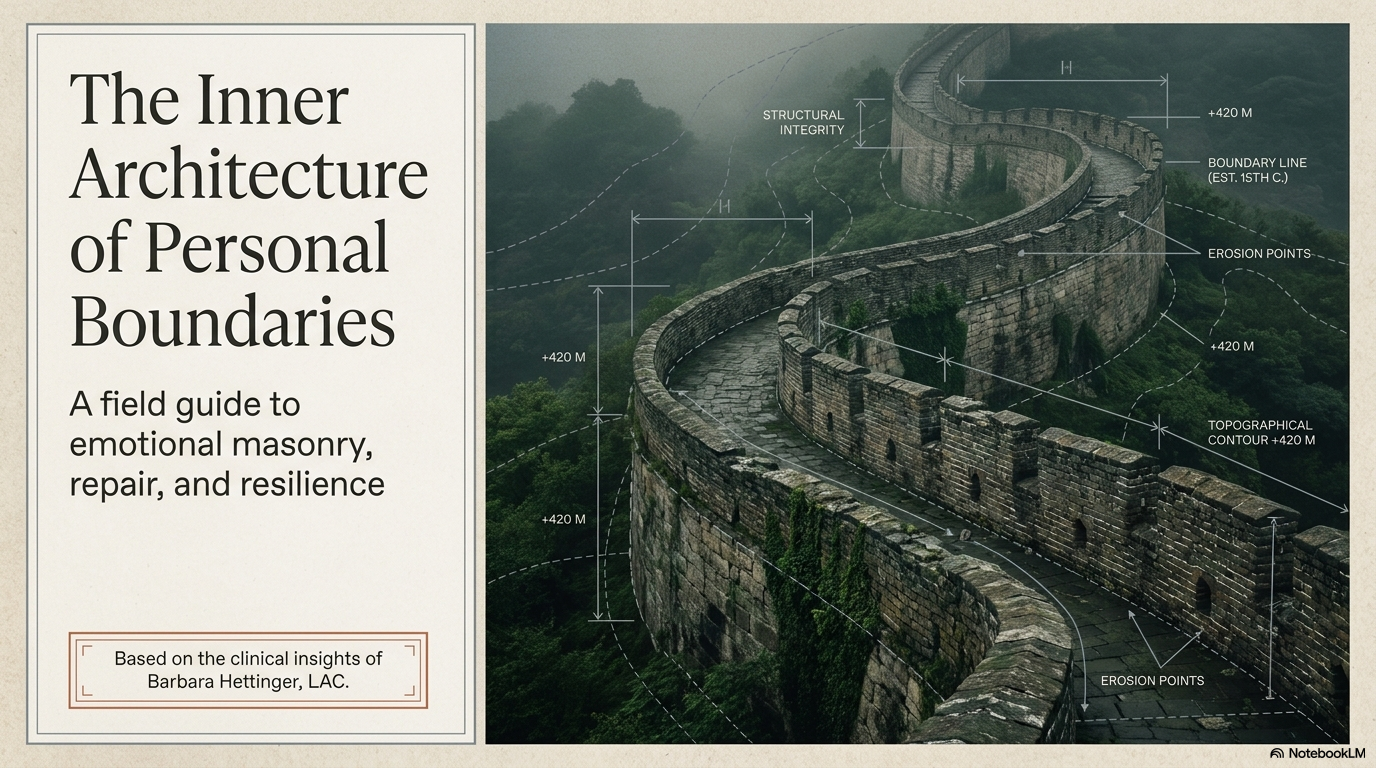
The Great Wall Isn't All in Good Shape (And Neither Are Your Boundaries)
Apr 23, 2026By Barbara Hettinger, LAC — Arizona Family Institute
Here's something I have to say out loud before we go anywhere with this conversation: you cannot control another human being. Not your mother. Not your spouse. Not your adult child. Not the neighbor. Not the coworker who keeps doing the thing. (see my video on this topic)
That's not a motivational statement. That's just the truth, and most of us spend a lot of energy trying to prove it wrong.
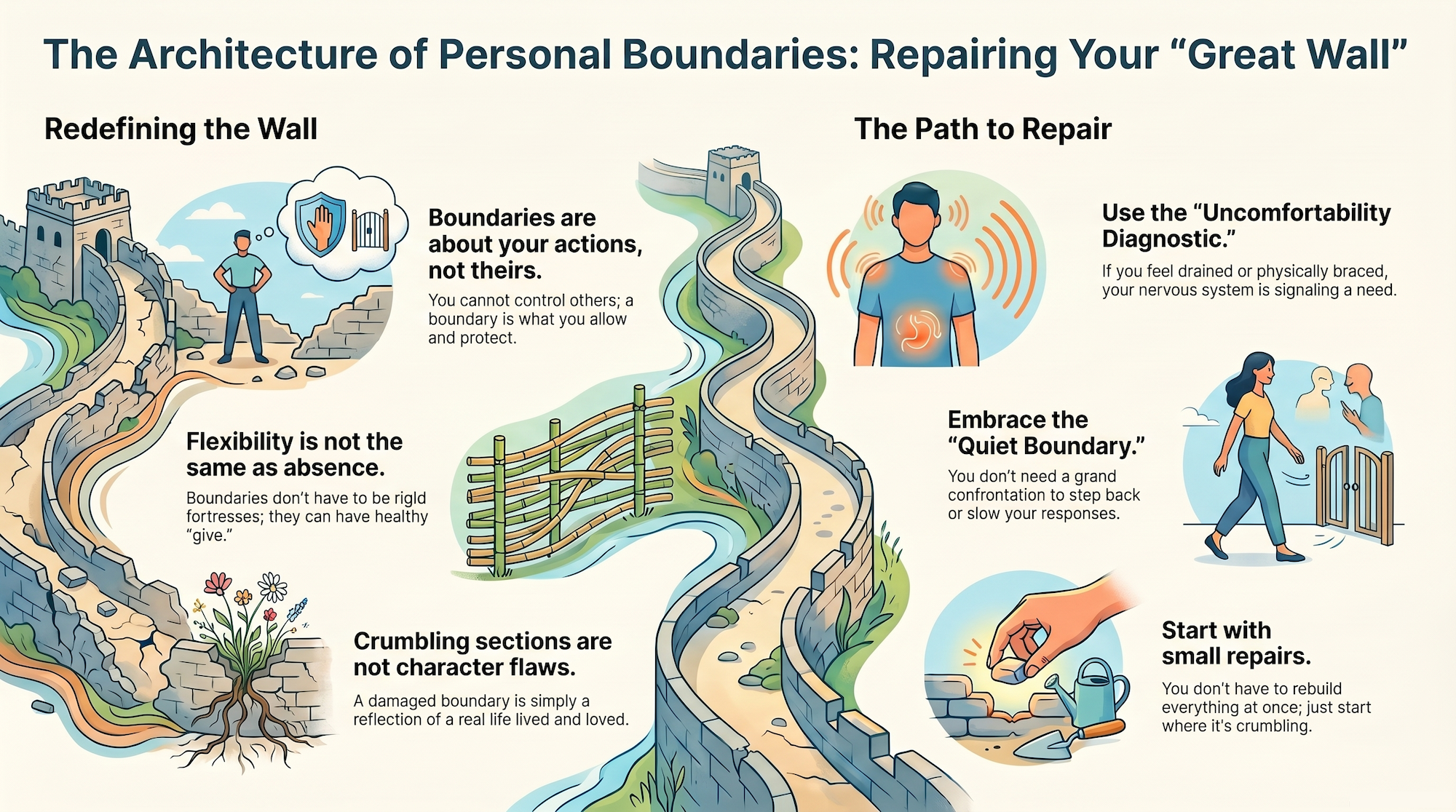
So when we talk about boundaries, I want to be really clear. A boundary is never about what someone else does. It's about what you do. It's about what you allow, what you walk toward, what you step back from, what you protect. Because here's the other truth — just because you set a boundary doesn't mean somebody won't come right over the top of it.
I think about the Great Wall of China when I talk about this.
Have you seen pictures of it? Some sections have been beautifully restored. The stones are tight, the edges are clean, and the path on top is wide enough to walk. People take photographs there. It looks invincible.
Other sections? They're crumbling. Trees growing through the cracks. Whole pieces tumbled down the hillside. If you tried to stand on that part of the wall, you'd fall right through.
That's how our boundaries actually are. Not one uniform, perfectly maintained structure. A long, winding wall across our lives — some stretches solid, some barely hanging on. And that's not a character flaw. That's just what it looks like to be a person who has lived a real life, loved real people, and been hurt in some places more than others.
The question isn't whether I have perfect boundaries. The question is: where are my crumbling, and what needs to be repaired?
Now here's something I want you to hear. Not every boundary has to be a fortress.
We get this idea sometimes — maybe from a book, maybe from a podcast — that boundaries have to be rigid to count. That's not true. Some of your boundaries get to be flexible. You might say, we don't really eat sweets in our house. But that doesn't have to mean never. It can mean that we usually don't, but on Sundays, we do. And sometimes when the whole family is out together, and it just feels right, we get ice cream. That's still a boundary. It's just one with some give.
Flexible isn't the same as absent.
And here's the other thing I want to unpack — because I see this one a lot in my office. A lot of people think that if they don't say the boundary out loud, dramatically, with a big declaration, then it doesn't count.
I have to tell her I don't like what she did. I have to announce that if she does it one more time, I'm never bringing the kids over again.
You don't.
You really don't.
You can just… gently pull back your time. You can say, quietly, to yourself, that person is a little hard for me to be around right now. I'm not cutting them off. I'm not making a speech. I'm just going to be a little less available for a while. That is a boundary. A firm one. And nobody had to get a lecture for it to exist.
We don't have to be confrontational for a boundary to be real.
Sometimes the most powerful boundaries are the quiet ones. The ones you keep mostly in your own heart. The stepping back. The slower reply. The "I'd love to, but I can't that weekend" said without needing to explain the whole thing.
So how do you know where you need one?
I'd ask you a simple question. Sit with it for a minute.
Am I uncomfortable in this area of my life?
That's it. That's the whole diagnostic.
If something is leaving you drained every time. If a particular relationship keeps producing the same bruise. If you notice your body bracing when a certain name comes up on your phone, your nervous system is already telling you something. You don't need a crisis to justify a boundary. You just need to notice that something isn't working, and take that seriously.
So take a walk along your wall this week. See what's standing. See what's crumbling. Decide, kindly and without panic, what needs repair.
You don't have to rebuild all of it at once. You just have to start.
Barbara Hettinger is a Licensed Associate Counselor at Arizona Family Institute in Mesa, Arizona.
Don't miss a beat!
New moves, motivation, and classes delivered to your inbox.
We hate SPAM. We will never sell your information, for any reason.
