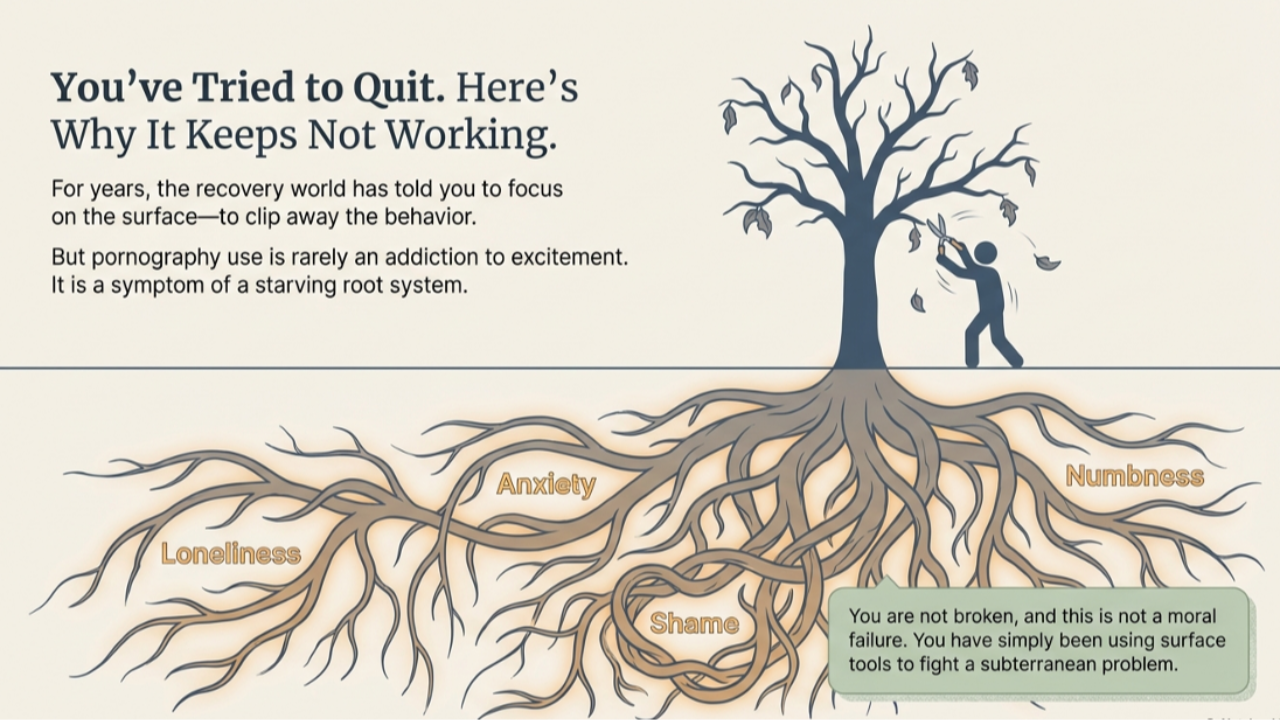
You've Tried to Quit Porn. Here's Why It Keeps Not Working.
Mar 19, 2026by Dan Oakes MEd LPC
A guy told me something a while back that I haven't stopped thinking about.
He said, I couldn't see that porn was affecting my ability to understand my own emotions — or anyone else's.
He'd started at fourteen. Not because he was chasing something exciting. Because he was lonely and didn't know what to do with that. Porn wasn't desire. It was management. A way to not feel what he was feeling without having to name it or survive it or ask anyone for help.
By the time he sat across from me he'd been trying to figure out how to quit porn for over a decade. He'd tried everything the recovery world had to offer. Accountability software. Filters. Promises. Confession. He'd read every porn addiction recovery tip he could find and applied most of them with genuine sincerity.
And he kept relapsing.
Not because he was weak. Because nobody had yet helped him look at what the porn was actually doing.
Most people don't come looking for porn addiction help on a good day. They come after the discovery, after the broken promise, after the quiet shame of another night that didn't go the way they swore it would. If that's you, take a breath. Understanding porn addiction is less about cataloging a behavior and more about listening to what the behavior has been trying to say. For most of the men and couples I sit with, the pattern isn't really about sex at all. It's about loneliness. Regulation. A nervous system that learned, somewhere along the way, that connection wasn't safe. If you love someone caught in this, and you're asking how to help someone with a porn addiction, the most powerful thing you can offer usually isn't advice. It's your presence, steady and unshocked, while they find words for what they've never said out loud.
This is not primarily an addiction problem
I'll say something here that might land differently than what you've heard before.
Porn is less about addiction and more about an attachment condition. An intimacy condition. It's more about negative emotions and the management of them than it is about chasing desire. Most people I sit with aren't watching porn because life is great and they want more excitement. They're watching porn because something inside them is dysregulated — lonely, anxious, ashamed, numb — and they found something that made it stop. Temporarily. Reliably. Without requiring anything vulnerable from them.
That's not a moral failure. That's a nervous system doing what nervous systems do — finding the fastest available route to relief.
The problem is that when porn becomes that route, something quietly breaks in a person's ability to feel their own emotions clearly, or to feel toward another person with any real depth. Like the client I mentioned — fourteen years old, already learning to outsource his emotional life to a screen. By the time he was an adult he didn't just have a porn problem. He had a feeling problem. He'd never really learned to sit inside his own discomfort long enough to understand it.
That's what overcoming porn addiction actually requires addressing. Not just the behavior. The interior life underneath it.
Why most recovery advice doesn't stick
Most of what's out there about how to stop watching adult content focuses on removal. Block the site. Install the filter. Tell someone. Avoid the trigger.
And none of that is wrong exactly. But it's incomplete in a way that matters.
Here's the clinical reality. How to rewire your brain is not a thirty day process and it is not primarily about subtraction. The brain that built a conditioned pathway to pornography — especially one that started in adolescence, when the neural architecture was still forming — built something durable. Repeated pairing of the most powerful neurochemical event the body produces with a specific stimulus creates an association that does not simply dissolve because you decided you wanted it to.
You can't just remove the behavior and leave an empty lot. The nervous system will rush back to fill it. Every time.
What actually creates new neural pathways is new repeated experience. Real experience. Embodied, relational, sometimes uncomfortable experience that teaches the nervous system there are other ways to regulate — ways that don't cost you your emotional intelligence or your marriage or your integrity.
That's the work. And it's harder and slower and more worthwhile than any list of porn addiction recovery tips is going to tell you.
How to stop relapse — the piece nobody talks about
I want to say something about the shame cycle because I think it's the most misunderstood piece of this whole thing.
For a lot of people — especially people of faith, people with strong moral convictions — shame doesn't interrupt the cycle. It fuels it. And I need you to hear that clearly because if it's true for you, it explains a lot.
Here's what happens neurologically. You relapse. The shame hits — total, identity-level, annihilating. I am disgusting. I am beyond help. The nervous system floods. The prefrontal cortex — the part of you that makes good decisions — goes partially offline. You isolate, because shame always isolates. You white-knuckle it for a while. And then the nervous system, exhausted and dysregulated from the effort of containment, reaches for the fastest available regulation.
Which it already knows.
The relapse doesn't happen despite the shame. In many cases it happens because of it.
So when people ask me how to stop relapse, part of my answer is always this: we have to interrupt the shame node first. Not because the behavior doesn't matter — it does — but because shame is not producing the outcome you think it's producing. It's producing the next relapse.
This is why the phrase I come back to again and again in recovery work is this.
We don't avoid and distract. We expect and respond.
You will feel the pull again. Expect it. When it comes, the question isn't how to make it go away — the question is what are you going to do with what you're feeling in that moment. What is the emotion underneath the urge. What does it need. What's the regulation strategy that isn't the screen.
That's a learnable skill. But you have to practice it when you're not in crisis. Which means you have to start paying attention to your emotional life in a way that porn use has probably been preventing.
What the four patterns taught me
Not everyone who struggles with porn is struggling with the same thing. I've come to understand four distinct patterns — the conditioned brain, the regulating brain, the wounded soul, the defended heart — and the reason that matters is that each one requires a genuinely different approach.
The person self-medicating an undiagnosed mood disorder needs a different kind of help than the person re-enacting sexual trauma. The person whose pornography use is an expression of intimacy anorexia — an active avoidance of real closeness with their partner — needs couples work in addition to individual therapy. The person caught in a shame cycle needs to learn that conviction and shame are not the same thing, and that one leads toward healing while the other leads toward the next relapse.
Starting with the right door matters. A lot.
What I want you to know if you've been trying and failing
If you have been trying to stop watching adult content for months or years — if you've read every article about how to quit porn and applied the strategies and still find yourself back in the same place — that is not evidence that you are beyond help.
It is evidence that you haven't yet found the right level of support for the actual root of what's driving this.
That root is findable. And once you find it, something shifts. Not overnight. But genuinely. I've watched it happen enough times to say that without qualification.
The goal isn't just sobriety. It's a person who has learned to feel their own emotions, regulate their own nervous system, and show up in real relationship without needing to escape. That's a different human being than the one who walked in. And it's available to you.
At Arizona Family Institute we work with this specific struggle — with clinical depth, with compassion, and with the belief that real recovery is possible. Not just stopping the behavior but healing what's underneath it. If you're ready to stop trying the same thing and getting the same result, reach out to us today. We'd be glad to help you find your door.
Don't miss a beat!
New moves, motivation, and classes delivered to your inbox.
We hate SPAM. We will never sell your information, for any reason.
